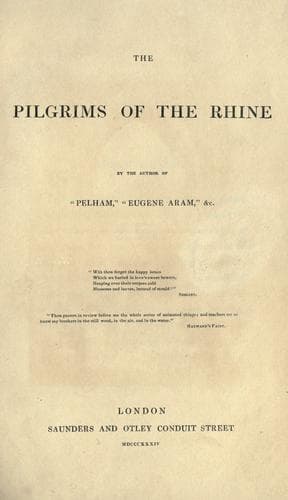
The Pilgrims of the RhineLytton, Edward Bulwer Lytton, Baron
Science
The Pilgrims of the Rhine
Lytton, Edward Bulwer Lytton, Baron
Fairies -- Fiction; Fantasy fiction; Rhine River Valley -- Fiction
With that, the fox began to cast in his head how he should get rid
of his rival, and at length he resolved on a very notable project; he
desired the cat to set out first, and wait for him at a turn in the road
a little way off. “For,” said he, “if we go together we shall certainly
be insulted by the dog; and he will know that in the presence of a lady,
the custom of a beast of my fashion will not suffer me to avenge the
affront. But when I am alone, the creature is such a coward that he will
not dare say his soul’s his own; leave the door open and I’ll follow
immediately.”
The cat’s mind was so completely poisoned against her cousin that she
implicitly believed this account of his character; and accordingly, with
many recommendations to her lover not to sully his dignity by getting
into any sort of quarrel with the dog, she set off first.
The dog went up to her very humbly, and begged her to allow him to say a
few words to her; but she received him so haughtily, that his spirit was
up; and he walked back to the tree more than ever enraged against his
rival. But what was his joy when he saw that the cat had left the door
open! “Now, wretch,” thought he, “you cannot escape me!” So he walked
briskly in at the back door. He was greatly surprised to find Reynard
lying down in the straw, panting as if his heart would break, and
rolling his eyes in the pangs of death.
“Ah, friend,” said the fox, with a faltering voice, “you are avenged,
my hour is come; I am just going to give up the ghost: put your paw upon
mine, and say you forgive me.”
Despite his anger, the generous dog could not set tooth on a dying foe.
“You have served me a shabby trick,” said he; “you have left me to
starve in a hole, and you have evidently maligned me with my cousin:
certainly I meant to be avenged on you; but if you are really dying,
that alters the affair.”
“Oh, oh!” groaned the fox, very bitterly; “I am past help; the poor cat
is gone for Doctor Ape, but he’ll never come in time. What a thing it
is to have a bad conscience on one’s death-bed! But wait till the cat
returns, and I’ll do you full justice with her before I die.”
The good-natured dog was much moved at seeing his mortal enemy in such a
state, and endeavoured as well as he could to console him.
“Oh, oh!” said the fox; “I am so parched in the throat, I am burning;”
and he hung his tongue out of his mouth, and rolled his eyes more
fearfully than ever.
“Is there no water here?” said the dog, looking round.
“Alas, no!--yet stay! yes, now I think of it, there is some in that
little hole in the wall; but how to get at it! It is so high that I
can’t, in my poor weak state, climb up to it; and I dare not ask such a
favour of one I have injured so much.”
“Don’t talk of it,” said the dog: “but the hole’s very small, I could
not put my nose through it.”
Public-domain text, read in full here on John Shaqi.
Reviews
Reviews
No reviews yet
Be the first to share your thoughts on this work.
Elsewhere in the archive
Join the Discussion
Join the discussion
Sign in to leave a comment or review.
Sign InorCreate an account