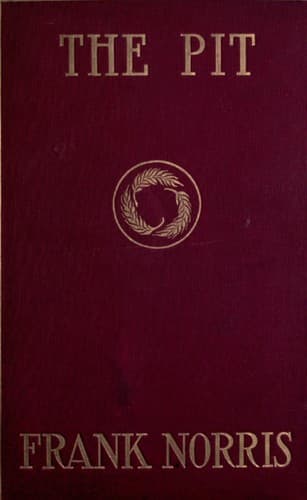
Chicago (Ill.) -- Fiction; Didactic fiction; Domestic fiction; Married people -- Fiction; Psychological fiction; Wheat trade -- Fiction
The woman in her was too complex, the fibres of character too intricate
and mature to be wrenched into new shapes by any sudden revolution. But
just so surely as the day was going, just so surely as the New Day
would follow upon the night, conception had taken place within her.
Whatever she did that evening, whatever came to her, through whatever
crises she should hurry, she would not now be quite the same. She had
been accustomed to tell herself that there were two Lauras. Now
suddenly, behold, she seemed to recognise a third--a third that rose
above and forgot the other two, that in some beautiful, mysterious way
was identity ignoring self.
But the change was not to be abrupt. Very, very vaguely the thoughts
came to her. The change would be slow, slow--would be evolution, not
revolution. The consummation was to be achieved in the coming years.
For to-night she was--what was she? Only a woman, weak, torn by
emotion, driven by impulse, and entering upon what she imagined was a
great crisis in her life.
But meanwhile the time was passing. Laura descended to the library and,
picking up a book, composed herself to read. When six o'clock struck,
she made haste to assure herself that of course she could not expect
him exactly on the hour. No, she must make allowances; the day--as Page
had suspected--had probably been an important one. He would be a little
late, but he would come soon. "If you love me, you will come," she had
said.
But an hour later Laura paced the room with tight-shut lips and burning
cheeks. She was still alone; her day, her hour, was passing, and he had
not so much as sent word. For a moment the thought occurred to her that
he might perhaps be in great trouble, in great straits, that there was
an excuse. But instantly she repudiated the notion.
"No, no," she cried, beneath her breath. "He should come, no matter
what has happened. Or even, at the very least, he could send word."
The minutes dragged by. No roll of wheels echoed under the carriage
porch; no step sounded at the outer door. The house was still, the
street without was still, the silence of the midsummer evening widened,
unbroken around her, like a vast calm pool. Only the musical Gregorians
of the newsboys chanting the evening's extras from corner to corner of
the streets rose into the air from time to time. She was once more
alone. Was she to fail again? Was she to be set aside once more, as so
often heretofore--set aside, flouted, ignored, forgotten? "If you love
me," she had said.
And this was to be the supreme test. This evening was to decide which
was the great influence of his life--was to prove whether or not love
was paramount. This was the crucial hour. "And he knows it," cried
Laura. "He knows it. He did not forget, could not have forgotten."
The half hour passed, then the hour, and as eight o'clock chimed from
the clock over the mantelshelf Laura stopped, suddenly rigid, in the
midst of the floor.
Public-domain text, read in full here on John Shaqi.
Reviews
Reviews
No reviews yet
Be the first to share your thoughts on this work.
Elsewhere in the archive
Join the Discussion
Join the discussion
Sign in to leave a comment or review.
Sign InorCreate an account