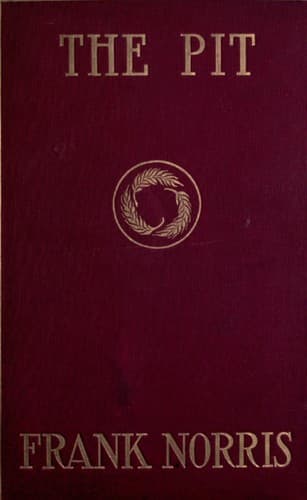
Chicago (Ill.) -- Fiction; Didactic fiction; Domestic fiction; Married people -- Fiction; Psychological fiction; Wheat trade -- Fiction
Laura stared. To her mind the word "gambling" had always been suspect.
It had a bad sound; it seemed to be associated with depravity of the
baser sort.
"Gambling!" she murmured.
"They call it buying and selling," he went on, "down there in La Salle
Street. But it is simply betting. Betting on the condition of the
market weeks, even months, in advance. You bet wheat goes up. I bet it
goes down. Those fellows in the Pit don't own the wheat; never even see
it. Wou'dn't know what to do with it if they had it. They don't care in
the least about the grain. But there are thousands upon thousands of
farmers out here in Iowa and Kansas or Dakota who do, and hundreds of
thousand of poor devils in Europe who care even more than the farmer. I
mean the fellows who raise the grain, and the other fellows who eat it.
It's life or death for either of them. And right between these two
comes the Chicago speculator, who raises or lowers the price out of all
reason, for the benefit of his pocket. You see Laura, here is what I
mean." Cressler had suddenly become very earnest. Absorbed, interested,
Laura listened intently. "Here is what I mean," pursued Cressler. "It's
like this: If we send the price of wheat down too far, the farmer
suffers, the fellow who raises it if we send it up too far, the poor
man in Europe suffers, the fellow who eats it. And food to the peasant
on the continent is bread--not meat or potatoes, as it is with us. The
only way to do so that neither the American farmer nor the European
peasant suffers, is to keep wheat at an average, legitimate value. The
moment you inflate or depress that, somebody suffers right away. And
that is just what these gamblers are doing all the time, booming it up
or booming it down. Think of it, the food of hundreds and hundreds of
thousands of people just at the mercy of a few men down there on the
Board of Trade. They make the price. They say just how much the peasant
shall pay for his loaf of bread. If he can't pay the price he simply
starves. And as for the farmer, why it's ludicrous. If I build a house
and offer it for sale, I put my own price on it, and if the price
offered don't suit me I don't sell. But if I go out here in Iowa and
raise a crop of wheat, I've got to sell it, whether I want to or not at
the figure named by some fellows in Chicago. And to make themselves
rich, they may make me sell it at a price that bankrupts me."
Laura nodded. She was intensely interested. A whole new order of things
was being disclosed, and for the first time in her life she looked into
the workings of political economy.
Public-domain text, read in full here on John Shaqi.
Reviews
Reviews
No reviews yet
Be the first to share your thoughts on this work.
Elsewhere in the archive
Join the Discussion
Join the discussion
Sign in to leave a comment or review.
Sign InorCreate an account