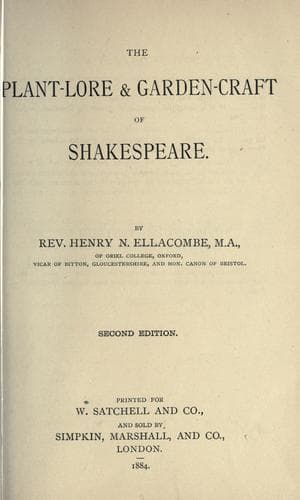
The plant-lore & garden-craft of ShakespeareEllacombe, Henry Nicholson
General
The plant-lore & garden-craft of Shakespeare
Ellacombe, Henry Nicholson
Gardens in literature; Plants in literature; Shakespeare, William, 1564-1616 -- Knowledge -- Botany
In a note Mr. Herttage says, "the oldest name for the plant was
_ymbglidegold_, that which moves round with the sun."
MARJORAM.
(1) _Perdita._
Here's flowers for you;
Hot Lavender, Mints, Savory, Marjoram.
_Winter's Tale_, act iv, sc. 4 (103).
(2) _Lear._
Give the word.
_Edgar._
Sweet Marjoram.
_Lear._
Pass.
_King Lear_, act iv, sc. 6 (93).
(3)
The Lily I condemned for thy hand,
And buds of Marjoram had stolen thy hair.
_Sonnet_ xcix.
(4) _Clown._
Indeed, sir, she was the sweet Marjoram of the Salad, or
rather the Herb-of-grace.
_All's Well that Ends Well_, act iv, sc. 5 (17).
In Shakespeare's time several species of Marjoram were grown, especially
the Common Marjoram (_Origanum vulgare_), a British plant, the Sweet
Marjoram (_O. Marjorana_), a plant of the South of Europe, from which
the English name comes,[159:1] and the Winter Marjoram (_O.
Horacleoticum_). They were all favourite pot herbs, so that Lyte calls
the common one "a delicate and tender herb," "a noble and odoriferous
plant;" but, like so many of the old herbs, they have now fallen into
disrepute. The comparison of a man's hair to the buds of Marjoram is not
very intelligible, but probably it was a way of saying that the hair was
golden.
FOOTNOTES:
[159:1] See "Catholicon Anglicum," s.v. Marioron and note.
MARYBUDS, _see_ MARIGOLD.
MAST.
_Timon._
The Oaks bear Mast, the Briers scarlet hips.
_Timon of Athens_, act iv, sc. 3 (174).
We still call the fruit of beech, beech-masts, but do not apply the name
to the acorn. It originally meant food used for fatting, especially for
fatting swine. See note in "Promptorium Parvulorum," p. 329, giving
several instances of this use, and Strattmann, s.v. Mæst.
MEDLAR.
(1) _Apemantus._
There's a Medlar for thee, eat it.
_Timon._
On what I hate I feed not.
_Apemantus._
Dost hate a Medlar?
_Timon._
Ay, though it looks like thee.
_Apemantus._
An thou hadst hated Meddlers sooner, thou shouldst have loved
thyself better now.
_Timon of Athens_, act iv, sc. 3 (305).
(2) _Lucio._
They would have married me to the rotten Medlar.
_Measure for Measure_, act iv, sc. 3 (183).
(3) _Touchstone._
Truly the tree yields bad fruit.
_Rosalind._
I'll graff it with you, and then I shall graff it with a
Medlar; then it will be the earliest fruit in the country,
for you'll be rotten ere you be half ripe, and that's the
right virtue of the Medlar.
_As You Like It_, act iii, sc. 2 (122).
(4) _Mercutio._
Public-domain text, read in full here on John Shaqi.
Reviews
Reviews
No reviews yet
Be the first to share your thoughts on this work.
Elsewhere in the archive
Join the Discussion
Join the discussion
Sign in to leave a comment or review.
Sign InorCreate an account