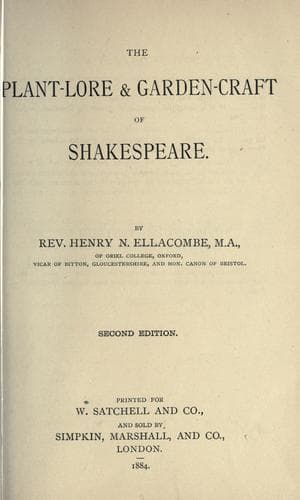
The plant-lore & garden-craft of ShakespeareEllacombe, Henry Nicholson
General
The plant-lore & garden-craft of Shakespeare
Ellacombe, Henry Nicholson
Gardens in literature; Plants in literature; Shakespeare, William, 1564-1616 -- Knowledge -- Botany
_Ibid._, act v, sc. 3 (152).
(21) _Casca._
I have seen tempests when the scolding winds
Have rived the knotty Oaks.
_Julius Cæsar_, act i, sc. 3 (5).
(22) _Celia._
I found him under a tree like a dropped Acorn.
_Rosalind._
It may well be called Jove's tree, when it drops forth such
fruit.
_As You Like It_, act iii, sc. 2 (248).
(23) _Prospero._
Thy food shall be
The fresh-brook muscles, wither'd roots, and husks
Wherein the Acorn cradled.
_Tempest_, act i, sc. 2 (462).
(24) _Puck._
All their elves for fear
Creep into Acorn-cups, and hide them there.
_Midsummer Night's Dream_, act ii, sc. 1 (30).
(25) _Lysander._
Get you gone, you dwarf--you beed--you Acorn!
_Ibid._, act iii, sc. 2 (328).
(26) _Posthumus._
Like a full-Acorned boar--a German one.
_Cymbeline_, act ii, sc. 5 (16).
(27) _Messenger._
About his head he weares the winner's Oke.
_Two Noble Kinsmen_, act iv, sc. 2 (154).
(28)
Time's glory is . . . .
To dry the old Oak's sap.
_Lucrece_ (950).
Here are several very pleasant pictures, and there is so much of
historical and legendary lore gathered round the Oaks of England that it
is very tempting to dwell upon them. There are the historical Oaks
connected with the names of William Rufus, Queen Elizabeth, and Charles
II.; there are the wonderful Oaks of Wistman's Wood (certainly the most
weird and most curious wood in England, if not in Europe); there are the
many passages in which our old English writers have loved to descant on
the Oaks of England as the very emblems of unbroken strength and
unflinching constancy; there is all the national interest which has
linked the glories of the British navy with the steady and enduring
growth of her Oaks; there is the wonderful picturesqueness of the great
Oak plantations of the New Forest, the Forest of Dean, and other royal
forests; and the equally, if not greater, picturesqueness of the English
Oak as the chief ornament of our great English parks; there is the
scientific interest which suggested the growth of the Oak for the plan
of our lighthouses, and many other interesting points. It is very
tempting to stop on each and all of these, but the space is too limited,
and they can all be found ably treated of and at full length in any of
the books that have been written on the English forest trees.
OATS.
(1) _Iris._
Ceres, most bounteous lady, thy rich leas
Of Wheat, Rye, Barley, Vetches, Oats, and Pease.
_Tempest_, act iv, sc. 1 (60).
(2) _Spring Song._
Public-domain text, read in full here on John Shaqi.
Reviews
Reviews
No reviews yet
Be the first to share your thoughts on this work.
Elsewhere in the archive
Join the Discussion
Join the discussion
Sign in to leave a comment or review.
Sign InorCreate an account