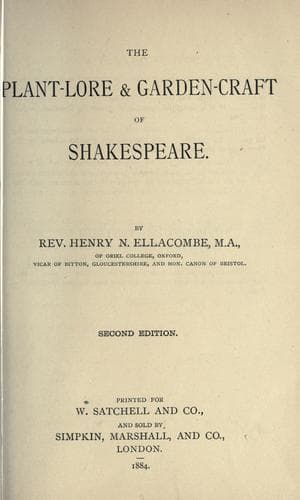
The plant-lore & garden-craft of ShakespeareEllacombe, Henry Nicholson
General
The plant-lore & garden-craft of Shakespeare
Ellacombe, Henry Nicholson
Gardens in literature; Plants in literature; Shakespeare, William, 1564-1616 -- Knowledge -- Botany
Pepper is the seed of Piper nigrum, "whose drupes form the black Pepper
of the shops when dried with the skin upon them, and white Pepper when
that flesh is removed by washing."--LINDLEY. It is, like all the
pepperworts, a native of the Tropics, but was well known both to the
Greeks and Romans. By the Greeks it was probably not much used, but in
Rome it seems to have been very common, if we may judge by Horace's
lines--
"Deferar in vicum, vendentem thus et odores,
Et piper, et quidquid chartis amicitur ineptis."
_Epistolæ_ ii, 1-270.
And in another place he mentions "Pipere albo" as an ingredient in
cooking. Juvenal mentions it as an article of commerce, "piperis coemti"
(Sat. xiv. 293). Persius speaks of it in more than one passage, and
Pliny describes it so minutely that he evidently not only knew the
imported spice, but also had seen the living plant. By the Romans it was
probably introduced into England, being frequently met with in the
Anglo-Saxon Leech-books. It is mentioned by Chaucer--
"And in an erthen pot how put is al,
And salt y-put in and also Paupere."
_Prologue of the Chanoune's Yeman._
It was apparently, like Ginger, a very common condiment in Shakespeare's
time, and its early introduction into England as an article of commerce
is shown by passages in our old law writers, who speak of the
reservation of rent, not only in money, but in "pepper, cummim, and
wheat;" whence arose the familiar reservation of a single peppercorn as
a rent so nominal as to have no appreciable pecuniary value.[204:1]
The red or Cayenne Pepper is made from the ground seeds of the
Capsicum, but I do not find that it was used to known in the sixteenth
century.
FOOTNOTES:
[204:1] Littleton does not mention Pepper when speaking of rents
reserved otherwise than in money, but specifies as instances, "un
chival, ou un esperon dor, ou un clovegylofer"--a horse, a golden spur,
or a clove gilliflower.
PIG-NUTS.
_Caliban._
I prythee let me bring thee where Crabs grow;
And I with my long nails will dig thee Pig-nuts.
_Tempest_, act ii, sc. 2 (171).
Public-domain text, read in full here on John Shaqi.
Reviews
Reviews
No reviews yet
Be the first to share your thoughts on this work.
Elsewhere in the archive
Join the Discussion
Join the discussion
Sign in to leave a comment or review.
Sign InorCreate an account