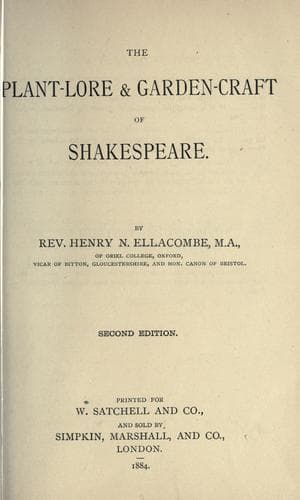
The plant-lore & garden-craft of ShakespeareEllacombe, Henry Nicholson
General
The plant-lore & garden-craft of Shakespeare
Ellacombe, Henry Nicholson
Gardens in literature; Plants in literature; Shakespeare, William, 1564-1616 -- Knowledge -- Botany
[240:1] I have only been able to find one record of the flowering of
Arundo donax in England--"Mem: Arundo donax in flower, 15th September,
1762, the first time I ever saw it, but this very hot dry summer has
made many exotics flower. . . . It bears a handsome tassel of
flowers."--P. COLLINSON'S _Hortus Collinsonianus_.
RHUBARB.
_Macbeth._
What Rhubarb, Cyme, or what purgative drug
Would scour these English hence?
_Macbeth_, act v, sc. 3 (55).
Andrew Boorde writing from Spayne in 1535, to Thomas Cromwell, says, "I
have sent to your Mastershipp the seeds of Reuberbe the whiche come
forth of Barbary in this parte ytt ys had for a grett tresure."[241:1]
But the plant does not seem to have become established and Shakespeare
could only have known the imported drug, for the Rheum was first grown
by Parkinson, though it had been described in an uncertain way both by
Lyte and Gerard. Lyte said: "Rha, as it is thought, hath great broad
leaves;" and then he says: "We have found here in the gardens of
certaine diligent herboristes that strange plant which is thought by
some to be Rha or Rhabarbum;" but from the figure it is very certain
that the plant was not a Rheum. After the time of Parkinson, it was
largely grown for the sake of producing the drug, and it is still grown
in England to some extent for the same purpose, chiefly in the
neighbourhood of Banbury; though it is doubtful whether any of the
species now grown in England are the true species that has long produced
Turkey Rhubarb. The plant is now grown most extensively as a spring
vegetable, though I cannot find when it first began to be so used.
Parkinson evidently tried it and thought well of it. "The leaves have a
fine acid taste; a syrup, therefore, made with the juice and sugar
cannot but be very effectual in dejected appetites." Yet even in 1807
Professor Martyn, the editor of "Millar's Dictionary," in a long article
on the Rhubarb, makes no mention of its culinary qualities, but in 1822
Phillips speaks of it as largely cultivated for spring tarts, and forced
for the London markets, "medical men recommending it as one of the most
cooling and wholesome tarts sent to table."
As a garden plant the Rhubarb is highly ornamental, though it is seldom
seen out of the kitchen garden, but where room can be given to them,
Rheum palmatum or Rheum officinale, will always be admired as some of
the handsomest of foliage plants. The finest species of the family is
the Himalayan Rheum nobile, but it is exceedingly difficult to grow.
Botanically the Rhubarb is allied to the Dock and Sorrel, and all the
species are herbaceous.
FOOTNOTES:
[241:1] Quoted in Furnival's forewords to Boorde's "Introduction to
Knowledge," p. 56.
RICE.
_Clown._
Let me see; what am I to buy for our sheep-shearing feast?
Three pound of sugar, five pound of Currants, Rice----What
will this sister of mine do with Rice?[242:1]
Public-domain text, read in full here on John Shaqi.
Reviews
Reviews
No reviews yet
Be the first to share your thoughts on this work.
Elsewhere in the archive
Join the Discussion
Join the discussion
Sign in to leave a comment or review.
Sign InorCreate an account