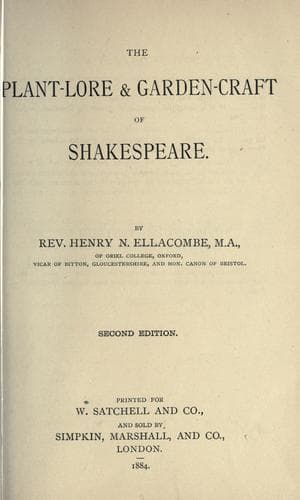
The plant-lore & garden-craft of ShakespeareEllacombe, Henry Nicholson
General
The plant-lore & garden-craft of Shakespeare
Ellacombe, Henry Nicholson
Gardens in literature; Plants in literature; Shakespeare, William, 1564-1616 -- Knowledge -- Botany
The White Rose has a very ancient interest for Englishmen, for "long
before the brawl in the Temple Gardens, the flower had been connected
with one of the most ancient names of our island. The elder Pliny, in
discussing the etymology of the word Albion, suggests that the land may
have been so named from the White Roses which abounded in it--'Albion
insula sic dicta ab albis rupibus, quas mare alluit, vel ob rosas
albas quibus abundat.' Whatever we may think of the etymological
skill displayed in the suggestion . . . we look with almost a new
pleasure on the Roses of our own hedgerows, when regarding them as
descended in a straight line from the 'rosas albas' of those far-off
summers."--_Quarterly Review_, vol. cxiv.
The Damask Rose (No. 5) remains to us under the same name, telling its
own history. There can be little doubt that the Rose came from Damascus,
probably introduced into Europe by the Crusaders or some of the early
travellers in the East, who speak in glowing terms of the beauties of
the gardens of Damascus. So Sir John Mandeville describes the city--"In
that Cytee of Damasce, there is gret plentee of Welles, and with in the
Cytee and with oute, ben many fayre Gardynes and of dyverse frutes. Non
other Cytee is not lyche in comparison to it, of fayre Gardynes, and of
fayre desportes."--_Voiage and Travaile_, cap. xi. And in our own day
the author of "Eöthen" described the same gardens as he saw them: "High,
high above your head, and on every side all down to the ground, the
thicket is hemmed in and choked up by the interlacing boughs that droop
with the weight of Roses, and load the slow air with their damask
breath. There are no other flowers. The Rose trees which I saw were all
of the kind we call 'damask;' they grow to an immense height and
size."--_Eöthen_, ch. xxvii. It was not till long after the Crusades
that the Damask Rose was introduced into England, for Hakluyt in 1582
says: "In time of memory many things have been brought in that were not
here before, as the Damaske Rose by Doctour Linaker, King Henry the
Seventh and King Henrie the Eight's Physician."--_Voiages_, vol.
ii.[252:1]
As an ornamental Rose the Damask Rose is still a favourite, though
probably the real typical Rosa Damascena is very seldom seen--but it has
been the parent of a large number of hybrid Roses, which the most
critical Rosarian does not reject. The whole family are very
sweet-scented, so that "sweet as Damask Roses" was a proverb, and Gerard
describes the common Damaske as "in other respects like the White Rose;
the especiale difference consisteth in the colour and smell of the
floures, for these are of a pale red colour and of a more pleasant
smell, and fitter for meate or medicine."
Public-domain text, read in full here on John Shaqi.
Reviews
Reviews
No reviews yet
Be the first to share your thoughts on this work.
Elsewhere in the archive
Join the Discussion
Join the discussion
Sign in to leave a comment or review.
Sign InorCreate an account