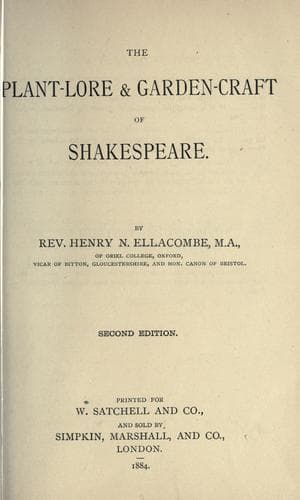
The plant-lore & garden-craft of ShakespeareEllacombe, Henry Nicholson
General
The plant-lore & garden-craft of Shakespeare
Ellacombe, Henry Nicholson
Gardens in literature; Plants in literature; Shakespeare, William, 1564-1616 -- Knowledge -- Botany
These, with the addition of the Eglantine or Sweet Brier (_see_
EGLANTINE), are the only Roses that Shakespeare directly names, and they
were the chief sorts grown in his time, but not the only sorts; and to
what extent Roses were cultivated in Shakespeare's time we have a
curious proof in the account of the grant of Ely Place, in Holborn, the
property of the Bishops of Ely. "The tenant was Sir Christopher Hatton
(Queen Elizabeth's handsome Lord Chancellor) to whom the greater portion
of the house was let in 1576 for the term of twenty-one years. The rent
was a Red Rose, ten loads of hay, and ten pounds per annum; Bishop Cox,
on whom this hard bargain was forced by the Queen, reserving to himself
and his successors the right of walking in the gardens, and gathering
twenty bushels of Roses yearly."--CUNNINGHAM. We have records also of
the garden cultivation of the Rose in London long before Shakespeare's
time. "In the Earl of Lincoln's garden in Holborn in 24 Edw. I., the
only flowers named are Roses, of which a quantity was sold, producing
three shillings and twopence."--HUDSON TURNER.
My space forbids me to enter more largely into any account of these old
species, or to say much of the many very interesting points in the
history of the Rose, but two or three points connected with
Shakespeare's Roses must not be passed over. First, its name. He says
through Juliet (No. 36) that the Rose by any other name would smell as
sweet. But the whole world is against him. Rose was its old Latin name
corrupted from its older Greek name, and the same name, with slight and
easily-traced differences, has clung to it in almost all European
countries.
Shakespeare also mentions its uses in Rose-water and Rose-cakes, and it
was only natural to suppose that a flower so beautiful and so sweet was
meant by Nature to be of great use to man. Accordingly we find that
wonderful virtues were attributed to it,[255:1] and an especial virtue
was attributed to the dewdrops that settled on the full-blown Rose.
Shakespeare alludes to these in Nos. 22 and 27; and from these were made
cosmetics only suited to the most extravagant.
"The water that did spryng from ground
She would not touch at all,
But washt her hands with dew of Heaven
That on sweet Roses fall."
_The Lamentable Fall of Queen Ellinor._--Roxburghe Ballads.
Public-domain text, read in full here on John Shaqi.
Reviews
Reviews
No reviews yet
Be the first to share your thoughts on this work.
Elsewhere in the archive
Join the Discussion
Join the discussion
Sign in to leave a comment or review.
Sign InorCreate an account