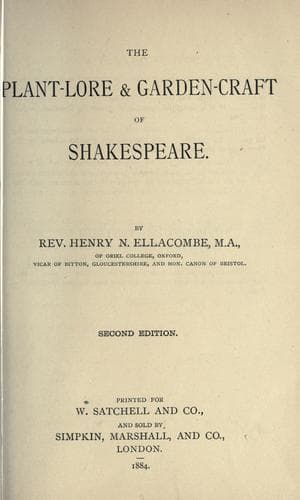
The plant-lore & garden-craft of ShakespeareEllacombe, Henry Nicholson
General
The plant-lore & garden-craft of Shakespeare
Ellacombe, Henry Nicholson
Gardens in literature; Plants in literature; Shakespeare, William, 1564-1616 -- Knowledge -- Botany
Saffron (from its Arabic name, _al zahafaran_) was not, in Shakespeare's
time, limited to the drug or to the Saffron-bearing Crocus (_C.
sativus_), but it was the general name for all the Croci, and was even
extended to the Colchicums, which were called Meadow Saffrons.[268:1] We
have no Crocus really a native of Britain, but a few species (C. vernus,
C. nudiflorus, C. aureus, and C. biflorus) have been so naturalized in
certain parts as to be admitted, though very doubtfully, into the
British flora; but the Saffron Crocus can in no way be considered a
native, and the history of its introduction into England is very
obscure. It is mentioned several times in the Anglo-Saxon Leech Books:
"When he bathes, let him smear himself with oil; mingle it with
Saffron."--_Tenth Century Leech Book_, ii. 37. "For dimness of eyes,
thus one must heal it: take Celandine one spoonful, and Aloes, and
Crocus (Saffron in French)."--_Schools of Medicine_, tenth century, c.
22. In these instances it may be only the imported drug; but the name
occurs in an English Vocabulary among the Nomina herbarum: "Hic Crocus,
A{e} Safurroun;" and in a Pictorial Vocabulary of the fourteenth
century, "Hic Crocus, An{ce} Safryn;" so that I think the plant must
have been in cultivation in England at that time. The usual statement,
made by one writer after another, is that it was introduced by Sir
Thomas Smith into the neighbourhood of Walden in the time of Edward
III., but the original authority for this statement is unknown. The most
authentic account is that by Hakluyt in 1582, and though it is rather
long, it is worth extracting in full. It occurs in some instructions in
"Remembrances for Master S.," who was going into Turkey, giving him
hints what to observe in his travels: "Saffron, the best of the
universall world, groweth in this realme. . . . It is a spice that is
cordiall, and may be used in meats, and that is excellent in dying of
yellow silks. This commodity of Saffron groweth fifty miles from
Tripoli, in Syria, on an high hyll, called in those parts Gasian, so as
there you may learn at that part of Tripoli the value of the pound, the
goodnesse of it, and the places of the vent. But it is said that from
that hyll there passeth yerely of that commodity fifteen moiles laden,
and that those regions notwithstanding lacke sufficiency of that
commodity. But if a vent might be found, men would in Essex (about
Saffron Walden), and in Cambridgeshire, revive the trade for the benefit
of the setting of the poore on worke. So would they do in Herefordshire
by Wales, where the best of all England is, in which place the soil
yields the wilde Saffron commonly, which showeth the natural inclination
of the same soile to the bearing of the right Saffron, if the soile be
manured and that way employed. . . It is reported at Saffron Walden that
a pilgrim, proposing to do good to his countrey, stole a head of
Saffron, and hid the same in his Palmer's staffe, which he had made
Public-domain text, read in full here on John Shaqi.
Reviews
Reviews
No reviews yet
Be the first to share your thoughts on this work.
Elsewhere in the archive
Join the Discussion
Join the discussion
Sign in to leave a comment or review.
Sign InorCreate an account