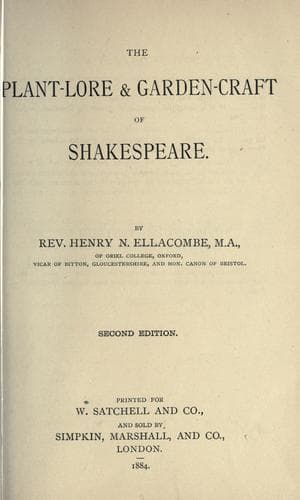
The plant-lore & garden-craft of ShakespeareEllacombe, Henry Nicholson
General
The plant-lore & garden-craft of Shakespeare
Ellacombe, Henry Nicholson
Gardens in literature; Plants in literature; Shakespeare, William, 1564-1616 -- Knowledge -- Botany
likely) the soil was not fitting, for they could never make any wine
that was worth the drinking, being so small and heartlesse, that they
soon gave over their practise."
There is no need to say anything of the modern culture of the Vine, or
its many excellent varieties. Even in Virgil's time the varieties
cultivated were so many that he said--
"Sed neque quam multæ species, nec nomina quæ sint
Est numerus; neque enim numero comprendere refert;
Quem qui scire velit, Lybici velit æquoris idem
Discere quam multæ Zephyro turbentur arenæ;
Aut ubi navigiis violentior incidit Eurus
Nosse quot Ionii veniant ad littora fluctus."
_Georgica_, ii, 103.
And now the number must far exceed those of Virgil's time. "The
cultivated varieties are extremely numerous; Count Odart says that he
will not deny that there may exist throughout the world 700 or 800,
perhaps even 1,000 varieties; but not a third of these have any
value."--DARWIN. These are the Grapes that are grown in our hothouses;
some also of a fine quality are produced in favourable years
out-of-doors. There are also a few which are grown as ornamental shrubs.
The Parsley-leaved Vine (_Vitis laciniosa_) is one that has been grown
in England, certainly since the time of Shakespeare, for its pretty
foliage, its fruit being small and few; but it makes a pretty covering
to a wall or trellis. The small Variegated Vine (_Vitis_ or _Cissus
heterophyllus variegatus_) is another very pretty Vine, forming a small
bush that may be either trained to a wall or grown as a low rockwork
bush; it bears a few Grapes of no value, and is perfectly hardy. Besides
these there are several North American species, which have handsome
foliage, and are very hardy, of which the Vitis riparia or Vigne des
Battures is a desirable tree, as "the flowers have an exquisitely fine
smell, somewhat resembling that of Mignonnette."--DON. I mention this
particularly, because in all the old authors great stress is laid on the
sweetness of the Vine in all its parts, a point of excellence in it
which is now generally overlooked. Lord Bacon reckons "Vine flowers"
among the "things of beauty in season" in May and June, and reckons
among the most sweet-scented flowers, next to Musk Roses and Strawberry
leaves dying, "the flower of the Vines; it is a little dust, like the
dust of a bent, which grows among the duster in the first coming
forth." And Chaucer says: "Scorners faren like the foul toode, that may
noughte endure the soote smel of the Vine roote when it
flourisheth."--_The Persones Tale._
Public-domain text, read in full here on John Shaqi.
Reviews
Reviews
No reviews yet
Be the first to share your thoughts on this work.
Elsewhere in the archive
Join the Discussion
Join the discussion
Sign in to leave a comment or review.
Sign InorCreate an account