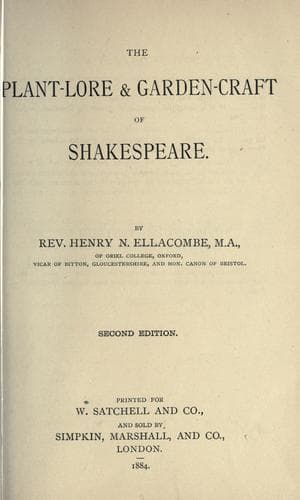
The plant-lore & garden-craft of ShakespeareEllacombe, Henry Nicholson
General
The plant-lore & garden-craft of Shakespeare
Ellacombe, Henry Nicholson
Gardens in literature; Plants in literature; Shakespeare, William, 1564-1616 -- Knowledge -- Botany
When Cytherea all in love forlorn
A longing tarriance for Adonis made
Under an Osier growing by a brook.
_Passionate Pilgrim_ vi.
(13)
Though to myself forsworn, to thee I'll constant prove;
Those thoughts, to me like Oaks, to thee like Osiers bow'd.
_Ibid._ v.
_See also_ PALM TREE, No. 1, p. 192.
Willow is an old English word, but the more common and perhaps the older
name for the Willow is Withy, a name which is still in constant use, but
more generally applied to the twigs when cut for basket-making than to
the living tree. "Withe" is found in the oldest vocabularies, but we do
not find "Willow" till we come to the vocabularies of the fifteenth
century, when it occurs as "Hæc Salex, A{e} Wyllo-tre;" "Hæc Salix-icis,
a Welogh;" "Salix, Welig." Both the names probably referred to the
pliability of the tree, and there was another name for it, the Sallow,
which was either a corruption of the Latin Salix, or was derived from a
common root. It was also called Osier.
The Willow is a native of Britain. It belongs to a large family
(_Salix_), numbering 160 species, of which we have seventeen distinct
species in Great Britain, besides many sub-species and varieties. So
common a plant, with the peculiar pliability of the shoots that
distinguishes all the family, was sure to be made much use of. Its more
common uses were for basket-making, for coracles, and huts, or
"Willow-cabins" (No. 1), but it had other uses in the elegancies and
even in the romance of life. The flowers of the early Willow (_S.
caprea_) did duty for and were called Palms on Palm Sunday (_see_ PALM),
and not only the flowers but the branches also seem to have been used in
decoration, a use which is now extinct. "The Willow is called _Salix_,
and hath his name _à saliendo_, for that it quicklie groweth up, and
soon becommeth a tree. Heerewith do they in some countries trim up their
parlours and dining roomes in sommer, and sticke fresh greene leaves
thereof about their beds for coolness."--NEWTON'S _Herball for the
Bible_.[321:1]
But if we only look at the poetry of the time of Shakespeare, and much
of the poetry before and after him, we should almost conclude that the
sole use of the Willow was to weave garlands for jilted lovers, male and
female. It was probably with reference to this that Shakespeare
represented poor mad Ophelia hanging her flowers on the "Willow tree
aslant the brook" (No. 6), and it is more pointedly referred to in Nos.
2, 4, 5, 7, 8, and 9. The feeling was expressed in a melancholy ditty,
which must have been very popular in the sixteenth century, of which
Desdemona says a few of the first verses (No. 7), and which concludes
thus--
Public-domain text, read in full here on John Shaqi.
Reviews
Reviews
No reviews yet
Be the first to share your thoughts on this work.
Elsewhere in the archive
Join the Discussion
Join the discussion
Sign in to leave a comment or review.
Sign InorCreate an account