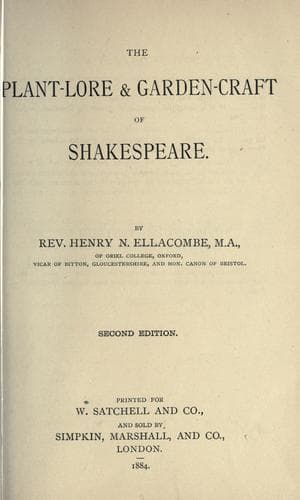
The plant-lore & garden-craft of ShakespeareEllacombe, Henry Nicholson
General
The plant-lore & garden-craft of Shakespeare
Ellacombe, Henry Nicholson
Gardens in literature; Plants in literature; Shakespeare, William, 1564-1616 -- Knowledge -- Botany
With April's first-born flowers, and all things rare,
That Heaven's air in this huge rondure hems.
_Ibid._ xxi.
(19)
The summer's flower is to the summer sweet,
Though to itself it only live and die;
But if that flower with base infection meet,
The basest weed outbraves his dignity:
For sweetest things turn sourest by their deeds;
Lilies that fester smell far worse than weeds.
_Ibid._ xciv.
(20)
Yet nor the lays of birds nor the sweet smell
Of different flowers in odour and in hue
Could make me any summer's story tell,
Or from their proud lap pluck them where they grew.
_Ibid._ xcviii.
"Of all the vain assumptions of these coxcombical times, that which
arrogates the pre-eminence in the true science of gardening is the
vainest. True, our conservatories are full of the choicest plants from
every clime: we ripen the Grape and the Pine-apple with an art unknown
before, and even the Mango, the Mangosteen, and the Guava are made to
yield their matured fruits; but the real beauty and poetry of a garden
are lost in our efforts after rarity, and strangeness, and variety." So,
nearly forty years ago, wrote the author of "The Poetry of Gardening," a
pleasant, though somewhat fantastic essay, first published in the
"Carthusian," and afterwards re-published in Murray's "Reading for the
Rail," in company with an excellent article from the "Quarterly" by the
same author under the title of "The Flower Garden;" and I quote it
because this "vain assumption" is probably stronger and more widespread
now than when that article was written. We often hear and read accounts
of modern gardening in which it is coolly assumed, and almost taken for
granted, that the science of horticulture, and almost the love of
flowers, is a product of the nineteenth century. But the love of flowers
is no new taste in Englishmen, and the science of horticulture is in no
way a modern science. We have made large progress in botanical science
during the present century, and our easy communications with the whole
habitable globe have brought to us thousands of new and beautiful plants
in endless varieties; and we have many helps in gardening that were
quite unknown to our forefathers. Yet there were brave old gardeners in
our forefathers' times, and a very little acquaintance with the
literature of the sixteenth century will show that in Shakespeare's time
there was a most healthy and manly love of flowers for their own sake,
and great industry and much practical skill in gardening. We might,
indeed, go much further back than the fifteenth century, and still find
the same love and the same skill. We have long lists of plants grown in
times before the Conquest, with treatises on gardening, in which there
Public-domain text, read in full here on John Shaqi.
Reviews
Reviews
No reviews yet
Be the first to share your thoughts on this work.
Elsewhere in the archive
Join the Discussion
Join the discussion
Sign in to leave a comment or review.
Sign InorCreate an account