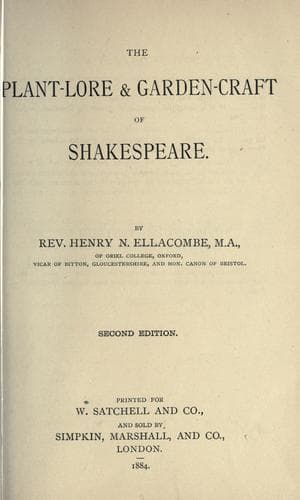
The plant-lore & garden-craft of ShakespeareEllacombe, Henry Nicholson
General
The plant-lore & garden-craft of Shakespeare
Ellacombe, Henry Nicholson
Gardens in literature; Plants in literature; Shakespeare, William, 1564-1616 -- Knowledge -- Botany
It standeth north-north-east and by east from the west corner
of thy curious-knotted Garden.
_Loves Labour's Lost_, act i, sc. 1 (248).
(2) _Isabella._
He hath a Garden circummured with brick,
Whose western side is with a Vineyard back'd;
And to that Vineyard is a planched gate
That makes his opening with this bigger key:
The other doth command a little door
Which from the Vineyard to the garden leads.
_Measure for Measure_, act iv, sc. 1 (28).
(3) _Antonio._
The Prince and Count Claudio, walking in a thick-pleached
alley in my orchard, were thus much overheard by a man of
mine.
_Much Ado About Nothing_, act i, sc. 2 (9).
(4) _Iago._
Our bodies are our Gardens, &c.
(_See_ HYSSOP.) _Othello_, act i, sc. 3 (323).
(5) _1st Servant._
Why should we, in the compass of a pale,
Keep law and form and due proportion,
Showing as in a model our firm estate,
When our sea-walled Garden, the whole land,
Is full of weeds, her fairest flowers choked up,
Her fruit-trees all unpruned, her hedges ruin'd,
Her knots disorder'd and her wholesome herbs
Swarming with caterpillars?
_Richard II_, act iii, sc. 4 (40).
The flower-gardens of Shakespeare's time were very different to the
flower-gardens of our day; but we have so many good descriptions of them
in books and pictures that we have no difficulty in realizing them both
in their general form and arrangement. I am now speaking only of the
flower-gardens; the kitchen-gardens and orchards were very much like our
own, except in the one important difference, that they had necessarily
much less glass than our modern gardens can command. In the
flower-garden the grand leading principle was uniformity and formality
carried out into very minute details. "The garden is best to be square,"
was Lord Bacon's rule; "the form that men like in general is a square,
though roundness be _forma perfectissima_," was Lawson's rule; and this
form was chosen because the garden was considered to be a purtenance and
continuation of the house, designed so as strictly to harmonize with the
architecture of the building. And Parkinson's advice was to the same
effect: "The orbicular or round form is held in its own proper existence
to be the most absolute form, containing within it all other forms
whatsoever; but few, I think, will chuse such a proportion to be joyned
to their habitation. The triangular or three-square form is such a form
also as is seldom chosen by any that may make another choise. The
four-square form is the most usually accepted with all, and doth best
agree with any man's dwelling."
This was the shape of the ideal garden--
Public-domain text, read in full here on John Shaqi.
Reviews
Reviews
No reviews yet
Be the first to share your thoughts on this work.
Elsewhere in the archive
Join the Discussion
Join the discussion
Sign in to leave a comment or review.
Sign InorCreate an account