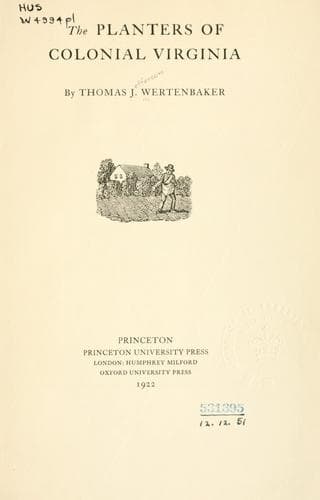
The Planters of Colonial VirginiaWertenbaker, Thomas Jefferson
History
The Planters of Colonial Virginia
Wertenbaker, Thomas Jefferson
Slavery -- Virginia; Virginia -- Economic conditions; Virginia -- History -- Colonial period, ca. 1600-1775
The houses of the small planters were small but comfortable. "Pleasant
in their building," says John Hammond, "which although for most part
they are but one story besides the loft, and built of wood, yet
contrived so delightfully that your ordinary houses in England are not
so handsome, for usually the rooms are large, daubed and whitelimed,
glazed and flowered, and if not glazed windows, shutters which are made
very pritty and convenient."[6-17] _The New Description of Virginia_,
published in 1649, says: "They have Lime in abundance for their houses,
store of bricks made, and House and Chimnies built of Brick, and some of
Wood high and fair, covered with Shingell for Tyle."[6-18]
In the days of the Company most of the houses seem to have been made of
logs, and Butler, in his _Virginia Unmasked_, declared that they were
the "worst in the world," and that the most wretched cottages in England
were superior to them.[6-19] But the period of which Butler wrote was
exceptional, and before long the growing prosperity of the colony made
possible a great improvement in the dwellings of the people. The rough
log cabin gave way to the little framed cottage with chimneys at each
end.
A residence erected in one of the parishes of the Eastern Shore in 1635
to serve as a parsonage may be accepted as typical of the better class
of houses in Virginia at this time. It was made of wood, was forty feet
wide, eighteen deep and had a chimney at each end. On either side was an
additional apartment, one used as a study, the other as a
buttery.[6-20] For the poor man this was far too pretentious, and he had
to content himself with a home perhaps thirty by twenty feet, containing
at times two or three apartments, at times only one.
But such as it was it gave him ample protection against the heat of
summer and the cold of winter. Fuel he never lacked. When the frosts of
December and January came upon him, he had only to repair to the nearest
forest, axe in hand, to supply himself with wood in abundance. In this
way, not only would he keep a roaring blaze in his open fireplace, but
would widen the space available for the next summer's tobacco crop.
The surroundings of the planter's residence were severely plain. In the
yard, which usually was uninclosed, towered a cluster of trees, a
survival of the primeval forest. Nearby was the garden, with its flowers
and vegetables, the dove-cote, the barn, the hen house, perhaps a milk
house or even a detached kitchen. In some cases wells were sunk, but the
use of natural springs was more common.[6-21]
Public-domain text, read in full here on John Shaqi.
Reviews
Reviews
No reviews yet
Be the first to share your thoughts on this work.
Elsewhere in the archive
Join the Discussion
Join the discussion
Sign in to leave a comment or review.
Sign InorCreate an account