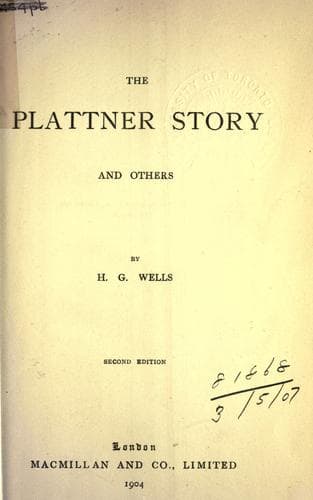
The Plattner Story, and OthersWells, H. G. (Herbert George)
Science
The Plattner Story, and Others
Wells, H. G. (Herbert George)
Great Britain -- Social life and customs -- Fiction; Science fiction; Short stories, English
Mr. Coombes was sick of life. He walked away from his unhappy home,
and, sick not only of his own existence, but of everybody else's,
turned aside down Gaswork Lane to avoid the town, and, crossing the
wooden bridge that goes over the canal to Starling's Cottages, was
presently alone in the damp pinewoods and out of sight and sound of
human habitation. He would stand it no longer. He repeated aloud with
blasphemies unusual to him that he would stand it no longer.
He was a pale-faced little man, with dark eyes and a fine and very
black moustache. He had a very stiff, upright collar slightly frayed,
that gave him an illusory double chin, and his overcoat (albeit
shabby) was trimmed with astrachan. His gloves were a bright brown
with black stripes over the knuckles, and split at the finger ends.
His appearance, his wife had said once in the dear, dead days beyond
recall,--before he married her, that is,--was military. But now she
called him-- It seems a dreadful thing to tell of between husband and
wife, but she called him "a little grub." It wasn't the only thing she
had called him, either.
The row had arisen about that beastly Jennie again. Jennie was his
wife's friend, and, by no invitation of Mr. Coombes, she came in every
blessed Sunday to dinner, and made a shindy all the afternoon. She was
a big, noisy girl, with a taste for loud colours and a strident laugh;
and this Sunday she had outdone all her previous intrusions by bringing
in a fellow with her, a chap as showy as herself. And Mr. Coombes,
in a starchy, clean collar and his Sunday frock-coat, had sat dumb
and wrathful at his own table, while his wife and her guests talked
foolishly and undesirably, and laughed aloud. Well, he stood that, and
after dinner (which, "as usual," was late), what must Miss Jennie do
but go to the piano and play banjo tunes, for all the world as if it
were a week-day! Flesh and blood could not endure such goings on. They
would hear next door, they would hear in the road, it was a public
announcement of their disrepute. He had to speak.
He had felt himself go pale, and a kind of rigour had affected his
respiration as he delivered himself. He had been sitting on one of
the chairs by the window--the new guest had taken possession of the
arm-chair. He turned his head. "Sun Day!" he said over the collar, in
the voice of one who warns. "Sun Day!" What people call a "nasty" tone
it was.
Jennie had kept on playing, but his wife, who was looking through
some music that was piled on the top of the piano, had stared at him.
"What's wrong now?" she said; "can't people enjoy themselves?"
"I don't mind rational 'njoyment, at all," said little Coombes, "but I
ain't a-going to have week-day tunes playing on a Sunday in this house."
"What's wrong with my playing now?" said Jennie, stopping and twirling
round on the music-stool with a monstrous rustle of flounces.
Public-domain text, read in full here on John Shaqi.
Reviews
Reviews
No reviews yet
Be the first to share your thoughts on this work.
Elsewhere in the archive
Join the Discussion
Join the discussion
Sign in to leave a comment or review.
Sign InorCreate an account