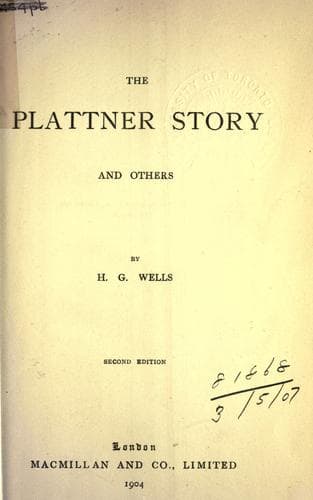
The Plattner Story, and OthersWells, H. G. (Herbert George)
Science
The Plattner Story, and Others
Wells, H. G. (Herbert George)
Great Britain -- Social life and customs -- Fiction; Science fiction; Short stories, English
That next Sunday, as I drank my tea, I interrogated my wife. "How is
this Sunday different from all other Sundays, little woman? What has
happened? Have you altered the curtains, or rearranged the furniture,
or where is the indefinable difference of it? Are you wearing your hair
in a new way without warning me? I clearly perceive a change in my
environment, and I cannot for the life of me say what it is."
Then my wife answered in her most tragic voice: "George," she said,
"that--that William has not come near the place to-day! And Jane is
crying her heart out upstairs."
There followed a period of silence. Jane, as I have said, stopped
singing about the house, and began to care for our brittle possessions,
which struck my wife as being a very sad sign indeed. The next Sunday,
and the next, Jane asked to go out, "to walk with William," and my
wife, who never attempts to extort confidences, gave her permission,
and asked no questions. On each occasion Jane came back looking
flushed and very determined. At last one day she became communicative.
"William is being led away," she remarked abruptly, with a catching of
the breath, apropos of tablecloths. "Yes, m'm. She is a milliner, and
she can play on the piano."
"I thought," said my wife, "that you went out with him on Sunday."
"Not out with him, m'm--after him. I walked along by the side of them,
and told her he was engaged to me."
"Dear me, Jane, did you? What did they do?"
"Took no more notice of me than if I was dirt. So I told her she should
suffer for it."
"It could not have been a very agreeable walk, Jane."
"Not for no parties, ma'am.
"I wish," said Jane, "I could play the piano, ma'am. But anyhow, I
don't mean to let _her_ get him away from me. She's older than him, and
her hair ain't gold to the roots, ma'am."
It was on the August Bank Holiday that the crisis came. We do not
clearly know the details of the fray, but only such fragments as poor
Jane let fall. She came home dusty, excited, and with her heart hot
within her.
The milliner's mother, the milliner, and William had made a party to
the Art Museum at South Kensington, I think. Anyhow, Jane had calmly
but firmly accosted them somewhere in the streets, and asserted her
right to what, in spite of the consensus of literature, she held to
be her inalienable property. She did, I think, go so far as to lay
hands on him. They dealt with her in a crushingly superior way. They
"called a cab." There was a "scene," William being pulled away into the
four-wheeler by his future wife and mother-in-law from the reluctant
hands of our discarded Jane. There were threats of giving her "in
charge."
"My poor Jane!" said my wife, mincing veal as though she was mincing
William. "It's a shame of them. I would think no more of him. He is not
worthy of you."
"No, m'm," said Jane. "He _is_ weak."
Public-domain text, read in full here on John Shaqi.
Reviews
Reviews
No reviews yet
Be the first to share your thoughts on this work.
Elsewhere in the archive
Join the Discussion
Join the discussion
Sign in to leave a comment or review.
Sign InorCreate an account