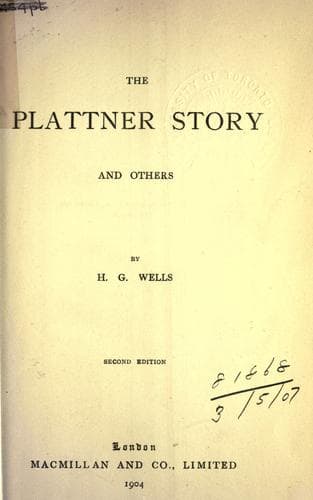
The Plattner Story, and OthersWells, H. G. (Herbert George)
Science
The Plattner Story, and Others
Wells, H. G. (Herbert George)
Great Britain -- Social life and customs -- Fiction; Science fiction; Short stories, English
The other woman's name was unpropitious,--Miss Smith,--but you would
never have suspected it from her face and costume. Her parentage
was promising, she was an orphan, her mother was a Hindoo, and her
father an Indian civil servant; and Aubrey Vair--himself a happy
mixture of Kelt and Teuton, as, indeed, all literary men have to be
nowadays--naturally believed in the literary consequences of a mixture
of races. She was dressed in white. She had finely moulded pale
features, great depth of expression, and a cloud of delicately _frisé_
black hair over her dark eyes, and she looked at Aubrey Vair with a
look half curious and half shy, that contrasted admirably with the
stereotyped frankness of your common Reigate girl.
"This is a splendid lawn--the best in Redhill," said Aubrey Vair in the
course of the conversation; "and I like it all the better because the
daisies are spared." He indicated the daisies with a graceful sweep of
his rather elegant hand.
"They are sweet little flowers," said the lady in white, "and I have
always associated them with England, chiefly, perhaps, through a
picture I saw 'over there' when I was very little, of children making
daisy chains. I promised myself that pleasure when I came home. But,
alas! I feel now rather too large for such delights."
"I do not see why we should not be able to enjoy these simple pleasures
as we grow older--why our growth should have in it so much forgetting.
For my own part"--
"Has your wife got Jane's recipe for stuffing trout?" asked Mrs.
Bayne's deaf aunt abruptly.
"I really don't know," said Aubrey Vair.
"That's all right," said Mrs. Bayne's deaf aunt. "It ought to please
even you."
"Anything will please me," said Aubrey Vair; "I care very little"--
"Oh, it's a lovely dish," said Mrs. Bayne's deaf aunt, and relapsed
into contemplation.
"I was saying," said Aubrey Vair, "that I think I still find my keenest
pleasures in childish pastimes. I have a little nephew that I see a
great deal of, and when we fly kites together, I am sure it would be
hard to tell which of us is the happier. By the bye, you should get at
your daisy chains in that way. Beguile some little girl."
"But I did. I took that Morton mite for a walk in the meadows, and
timidly broached the subject. And she reproached me for suggesting
'frivolous pursuits.' It was a horrible disappointment."
"The governess here," said Aubrey Vair, "is robbing that child of its
youth in a terrible way. What will a life be that has no childhood at
the beginning?"
"Some human beings are never young," he continued, "and they never
grow up. They lead absolutely colourless lives. They are--they are
etiolated. They never love, and never feel the loss of it. They
are--for the moment I can think of no better image--they are human
flower-pots, in which no soul has been planted. But a human soul
properly growing must begin in a fresh childishness."
Public-domain text, read in full here on John Shaqi.
Reviews
Reviews
No reviews yet
Be the first to share your thoughts on this work.
Elsewhere in the archive
Join the Discussion
Join the discussion
Sign in to leave a comment or review.
Sign InorCreate an account