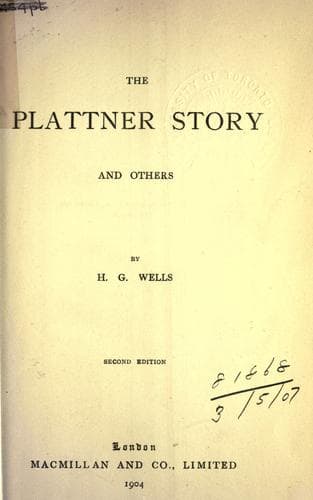
The Plattner Story, and OthersWells, H. G. (Herbert George)
Science
The Plattner Story, and Others
Wells, H. G. (Herbert George)
Great Britain -- Social life and customs -- Fiction; Science fiction; Short stories, English
After these two occurrences, there was a disposition on the part of
the expedition to leave Pollock to himself, and Pollock became, for
the first time in his life, anxious to mingle with blacks. Waterhouse
took one canoe, and Pollock, in spite of a friendly desire to chat
with Waterhouse, had to take the other. He was left all alone in the
front part of the canoe, and he had the greatest trouble to make the
men--who did not love him--keep to the middle of the river, a clear
hundred yards or more from either shore. However, he made Shakespear,
the Freetown half-breed, come up to his own end of the canoe and tell
him about Porroh, which Shakespear, failing in his attempts to leave
Pollock alone, presently did with considerable freedom and gusto.
The day passed. The canoe glided swiftly along the ribbon of lagoon
water, between the drift of water-figs, fallen trees, papyrus, and
palm-wine palms, and with the dark mangrove swamp to the left, through
which one could hear now and then the roar of the Atlantic surf.
Shakespear told in his soft, blurred English of how the Porroh could
cast spells; how men withered up under their malice; how they could
send dreams and devils; how they tormented and killed the sons of
Ijibu; how they kidnapped a white trader from Sulyma who had maltreated
one of the sect, and how his body looked when it was found. And Pollock
after each narrative cursed under his breath at the want of missionary
enterprise that allowed such things to be, and at the inert British
Government that ruled over this dark heathendom of Sierra Leone. In
the evening they came to the Kasi Lake, and sent a score of crocodiles
lumbering off the island on which the expedition camped for the night.
The next day they reached Sulyma, and smelt the sea breeze, but Pollock
had to put up there for five days before he could get on to Freetown.
Waterhouse, considering him to be comparatively safe here, and within
the pale of Freetown influence, left him and went back with the
expedition to Gbemma, and Pollock became very friendly with Perera,
the only resident white trader at Sulyma--so friendly, indeed, that he
went about with him everywhere. Perera was a little Portuguese Jew, who
had lived in England, and he appreciated the Englishman's friendliness
as a great compliment.
For two days nothing happened out of the ordinary; for the most part
Pollock and Perera played Nap--the only game they had in common--and
Pollock got into debt. Then, on the second evening, Pollock had a
disagreeable intimation of the arrival of the Porroh man in Sulyma by
getting a flesh-wound in the shoulder from a lump of filed iron. It
was a long shot, and the missile had nearly spent its force when it
hit him. Still it conveyed its message plainly enough. Pollock sat up
in his hammock, revolver in hand, all that night, and next morning
confided, to some extent, in the Anglo-Portuguese.
Public-domain text, read in full here on John Shaqi.
Reviews
Reviews
No reviews yet
Be the first to share your thoughts on this work.
Elsewhere in the archive
Join the Discussion
Join the discussion
Sign in to leave a comment or review.
Sign InorCreate an account