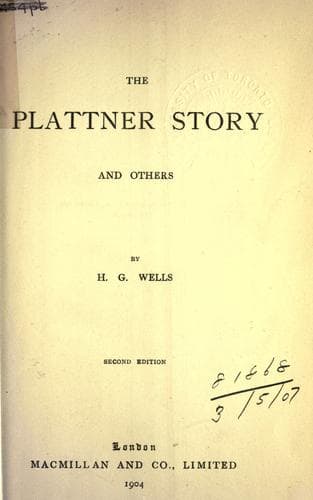
The Plattner Story, and OthersWells, H. G. (Herbert George)
Science
The Plattner Story, and Others
Wells, H. G. (Herbert George)
Great Britain -- Social life and customs -- Fiction; Science fiction; Short stories, English
Pollock pulled himself together, and went and picked up the head. He
would hang it up by the lamp-hook in the middle of the ceiling of his
room, and dig a grave for it at once. He was under the impression that
he hung it up by the hair, but that must have been wrong, for when he
returned for it, it was hanging by the neck upside down.
He buried it before sunset on the north side of the shed he occupied,
so that he should not have to pass the grave after dark when he was
returning from Perera's. He killed two snakes before he went to
sleep. In the darkest part of the night he awoke with a start, and
heard a pattering sound and something scraping on the floor. He sat up
noiselessly, and felt under his pillow for his revolver. A mumbling
growl followed, and Pollock fired at the sound. There was a yelp, and
something dark passed for a moment across the hazy blue of the doorway.
"A dog!" said Pollock, lying down again.
In the early dawn he awoke again with a peculiar sense of unrest. The
vague pain in his bones had returned. For some time he lay watching the
red ants that were swarming over the ceiling, and then, as the light
grew brighter, he looked over the edge of his hammock and saw something
dark on the floor. He gave such a violent start that the hammock
overset and flung him out.
He found himself lying, perhaps, a yard away from the head of the
Porroh man. It had been disinterred by the dog, and the nose was
grievously battered. Ants and flies swarmed over it. By an odd
coincidence, it was still upside down, and with the same diabolical
expression in the inverted eyes.
Pollock sat paralysed, and stared at the horror for some time. Then
he got up and walked round it--giving it a wide berth--and out of the
shed. The clear light of the sunrise, the living stir of vegetation
before the breath of the dying land-breeze, and the empty grave with
the marks of the dog's paws, lightened the weight upon his mind a
little.
He told Perera of the business as though it was a jest--a jest to be
told with white lips. "You should not have frighten de dog," said
Perera, with poorly simulated hilarity.
The next two days, until the steamer came, were spent by Pollock in
making a more effectual disposition of his possession. Overcoming
his aversion to handling the thing, he went down to the river mouth
and threw it into the sea-water, but by some miracle it escaped the
crocodiles, and was cast up by the tide on the mud a little way up
the river, to be found by an intelligent Arab half-breed, and offered
for sale to Pollock and Perera as a curiosity, just on the edge of
night. The native hung about in the brief twilight, making lower and
lower offers, and at last, getting scared in some way by the evident
dread these wise white men had for the thing, went off, and, passing
Pollock's shed, threw his burden in there for Pollock to discover in
the morning.
Public-domain text, read in full here on John Shaqi.
Reviews
Reviews
No reviews yet
Be the first to share your thoughts on this work.
Elsewhere in the archive
Join the Discussion
Join the discussion
Sign in to leave a comment or review.
Sign InorCreate an account