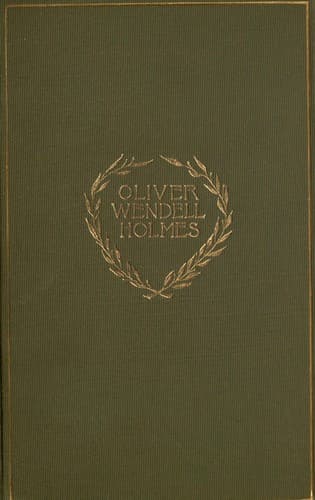
The Poet at the Breakfast-TableHolmes, Oliver Wendell
General
The Poet at the Breakfast-Table
Holmes, Oliver Wendell
American fiction -- 19th century; Conversation -- Fiction; Poetry
Sir, I believe,--the Master rose from his chair as he spoke, and said in
a deep and solemn tone, but without any declamatory vehemence,--sir, I
believe that we are at this moment in what will be recognized not many
centuries hence as one of the late watches in the night of the dark
ages. There is a twilight ray, beyond question. We know something of the
universe, a very little, and, strangely enough, we know most of what is
farthest from us. We have weighed the planets and analyzed the flames of
the--sun and stars. We predict their movements as if they were machines
we ourselves had made and regulated. We know a good deal about the earth
on which we live. But the study of man has been so completely subjected
to our preconceived opinions, that we have got to begin all over again.
We have studied anthropology through theology; we have now to begin
the study of theology through anthropology. Until we have exhausted the
human element in every form of belief, and that can only be done by what
we may call comparative spiritual anatomy, we cannot begin to deal with
the alleged extra-human elements without blundering into all imaginable
puerilities. If you think for one moment that there is not a single
religion in the world which does not come to us through the medium of
a preexisting language; and if you remember that this language embodies
absolutely nothing but human conceptions and human passions, you will
see at once that every religion presupposes its own elements as already
existing in those to whom it is addressed. I once went to a church in
London and heard the famous Edward Irving preach, and heard some of
his congregation speak in the strange words characteristic of their
miraculous gift of tongues. I had a respect for the logical basis of
this singular phenomenon. I have always thought it was natural that
any celestial message should demand a language of its own, only to be
understood by divine illumination. All human words tend, of course, to
stop short in human meaning. And the more I hear the most sacred terms
employed, the more I am satisfied that they have entirely and radically
different meanings in the minds of those who use them. Yet they deal
with them as if they were as definite as mathematical quantities or
geometrical figures. What would become of arithmetic if the figure 2
meant three for one man and five for another and twenty for a third, and
all the other numerals were in the same way variable quantities? Mighty
intelligent correspondence business men would have with each other! But
how is this any worse than the difference of opinion which led a famous
clergyman to say to a brother theologian, “Oh, I see, my dear sir, your
God is my Devil.”
Public-domain text, read in full here on John Shaqi.
Reviews
Reviews
No reviews yet
Be the first to share your thoughts on this work.
Elsewhere in the archive
Join the Discussion
Join the discussion
Sign in to leave a comment or review.
Sign InorCreate an account