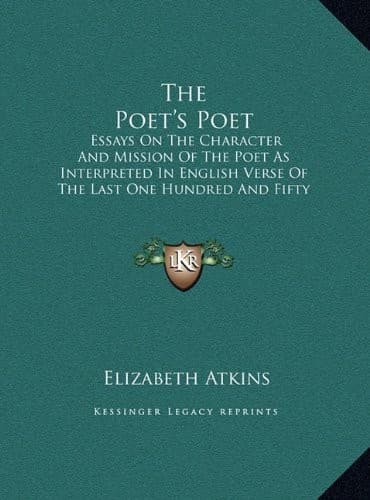
The Poet's Poet : essays on the character and mission of the poet as interpreted in English verse of the last one hundred and fifty yearsAtkins, Elizabeth
History
The Poet's Poet : essays on the character and mission of the poet as interpreted in English verse of the last one hundred and fifty years
Atkins, Elizabeth
American poetry -- History and criticism; English poetry -- History and criticism; Poetry
What quality went to form a man of achievement, especially in
literature, and which Shakespeare possessed so enormously--I mean
_Negative Capability_, that is, when a man is capable of being in
uncertainties, mysteries, doubts, without any irritable reaching after
fact and reason. Coleridge, for instance, would let go by a fine
isolated verisimilitude caught from the Pentralium of mystery, from
being incapable of remaining content with half-knowledge--With a great
poet the sense of Beauty overcomes every other consideration, or rather
obliterates all consideration.
Plato would agree with this,--all but the last sentence. Only, in place
of the phrase "negative capability," he would substitute "incapability,"
and reflect that the poet fails to see absolute beauty because he is not
content to leave the sensual behind and press on to absolute reality.
It may be that Plato is right, yet one cannot help wishing that sometime
a poet may arise of greater power of persuasion than any with whom we
have dealt, who will prove to Plato what he appears ever longing to be
convinced of, that absolute ideality is not a negation of the sensual,
and that poetry, in revealing the union of sense and spirit, is the
strongest proof of idealism that we possess. A poet may yet arise who
will prove that he is right in refusing to acknowledge that this world
is merely a surface upon which is reflected the ideals which constitute
reality and which abide in a different realm. The assumption in that
conception is that, if men have spiritual vision, they may apprehend
ideals directly, altogether apart from sense. On the contrary, the
impression given by the poet is that ideality constitutes the very
essence of the so-called physical world, and that this essence is
continually striving to express itself through refinement and remolding
of the outer crust of things. So, when the world of sense comes to
express perfectly the ideal, it will not be a mere representation of
reality. It will be reality. If he can prove this, we must acknowledge
that, not the rationalistic philosopher, but the poet, grasps reality
_in toto_.
However inconclusive his proof, the claims of the poet must fascinate
one with their implications. The two aspects of human life, the physical
and the ideal, focus in the poet, and the result is the harmony which is
art. The fact is of profound philosophical significance, surely, for
union of the apparent contradictions of the sensual and the spiritual
can only mean that idealism is of the essence of the universe. What is
the poetic metaphor but the revelation of an identical meaning in the
physical and spiritual world? The sympathetic reader of poetry cannot
but see the reflection of the spiritual in the sensual, and the sensual
in the spiritual, even as does the poet, and one, as the other, must be
by temperament an idealist.
INDEX
Public-domain text, read in full here on John Shaqi.
Reviews
Reviews
No reviews yet
Be the first to share your thoughts on this work.
Elsewhere in the archive
Join the Discussion
Join the discussion
Sign in to leave a comment or review.
Sign InorCreate an account