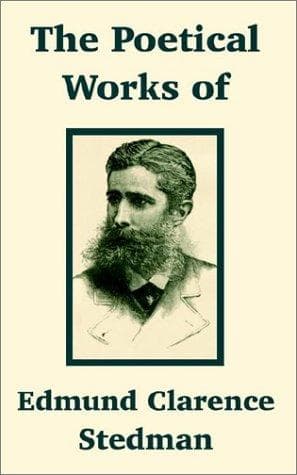
The poetical works of Edmund Clarence StedmanStedman, Edmund Clarence
General
The poetical works of Edmund Clarence Stedman
Stedman, Edmund Clarence
American poetry -- 19th century
Earth, let thy softest mantle rest
On this worn child to thee returning,
Whose youth was nurtured at thy breast,
Who loved thee with such tender yearning!
He knew thy fields and woodland ways,
And deemed thy humblest son his brother:—
Asleep, beyond our blame or praise,
We yield him back, O gentle Mother!
Of praise, of blame, he drank his fill:
Who has not read the life-long story?
And dear we hold his fame, but still
The man was dearer than his glory.
And now to us are left alone
The closet where his shadow lingers,
The vacant chair,—that was a throne,—
The pen, just fallen from his fingers.
Wrath changed to kindness on that pen;
Though dipped in gall, it flowed with honey;
One flash from out the cloud, and then
The skies with smile and jest were sunny.
Of hate he surely lacked the art,
Who made his enemy his lover:
O reverend head and Christian heart!
Where now their like the round world over?
He saw the goodness, not the taint,
In many a poor, do-nothing creature,
And gave to sinner and to saint,
But kept his faith in human nature;
Perchance he was not worldly-wise,
Yet we who noted, standing nearer,
The shrewd, kind twinkle in his eyes,
For every weakness held him dearer.
Alas that unto him who gave
So much, so little should be given!
Himself alone he might not save
Of all for whom his hands had striven.
Place, freedom, fame, his work bestowed:
Men took, and passed, and left him lonely;—
What marvel if, beneath his load,
At times he craved—for justice only!
Yet thanklessness, the serpent’s tooth,
His lofty purpose could not alter;
Toil had no power to bend his youth,
Or make his lusty manhood falter;
From envy’s sling, from slander’s dart,
That armored soul the body shielded,
Till one dark sorrow chilled his heart,
And then he bowed his head and yielded.
Now, now, we measure at its worth
The gracious presence gone forever!
The wrinkled East, that gave him birth,
Laments with every laboring river;
Wild moan the free winds of the West
For him who gathered to her prairies
The sons of men, and made each crest
The haunt of happy household fairies;
And anguish sits upon the mouth
Of her who came to know him latest:
His heart was ever thine, O South!
He was thy truest friend, and greatest!
He shunned thee in thy splendid shame,
He stayed thee in thy voiceless sorrow;
The day thou shalt forget his name,
Fair South, can have no sadder morrow.
The tears that fall from eyes unused,—
The hands above his grave united,—
The words of men whose lips he loosed,
Whose cross he bore, whose wrongs he righted,—
Could he but know, and rest with this!
Yet stay, through Death’s low-lying hollow,
His one last foe’s insatiate hiss
On that benignant shade would follow!
Public-domain text, read in full here on John Shaqi.
Reviews
Reviews
No reviews yet
Be the first to share your thoughts on this work.
Elsewhere in the archive
Join the Discussion
Join the discussion
Sign in to leave a comment or review.
Sign InorCreate an account