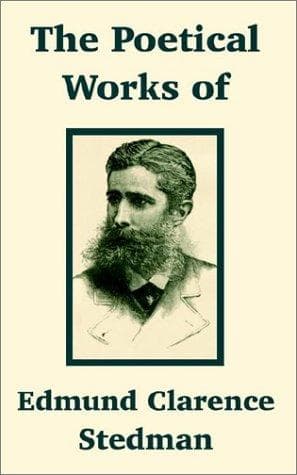
The poetical works of Edmund Clarence StedmanStedman, Edmund Clarence
General
The poetical works of Edmund Clarence Stedman
Stedman, Edmund Clarence
American poetry -- 19th century
Fell on it, and that moment the strong stay,
Which held her from the instinct of her wrong,
Broke, and therewith the whole device gave way,
The grand ideal she had watched so long:
As if a tower should fall, and on the plain
Only a scathed and broken pile remain.
But in its stead she would not measure yet
The counter-chance, nor deem this sole attaint
Made the Prince less than one in whom ’twas set
To prove him man. “I held him as a saint,”
She thought, “no other:—of all men alone
My blameless one! Too high my faith had flown:
“So be it!” With a sudden bitter scorn
She said: “You were his plaything, then! the food
Wherewith he dulled what appetite is born,
Of the gross kind, in men. His nobler mood
You knew not! How, shall I,—the fountain life
Of yonder children,—his embosomed wife
“Through all these years,—shall I, his Queen, for this
Sin-smitten harlot’s gage of an hour’s shame,
Misdoubt him?”—“Yes, I was his harlot,—yes,
God help me! and had worn the loathly name
Before the world, to have him in that guise!”
“Thou strumpet! wilt thou have me of his prize
“Rob Satan?” cried the Queen, and one step moved.
“Queen, if you loved him, save me from your bane,
As something that was dear to him you loved!”
Then from beneath her serge she took the chain
Which, long ago in that lone wood, the Prince
Hung round her,—she had never loosed it since,—
And gave therewith the face which, in its years
Of youthful, sunniest grace, a limner drew;
And unsigned letters, darkened with her tears,
Writ in the hand that hapless sovereign knew
Too well;—then told the whole, strange, secret tale,
As if with Heaven that penance could avail,
Or with the Queen, who heard as idols list
The mad priest’s cry, nor changed her place nor moaned,
But, clutching those mute tokens of each tryst,
Hid them about her. But the other groaned:
“The picture,—let me see it ere I die,—
Then take them all! once, only!”—At that cry
The Queen strode forward with an awful stride,
And seized the dying one, and bore her down,
And rose her height, and said, “Thou shouldst have died
Ere telling this, nor I have worn a crown
To hear it told. I am of God accurst!
Of all his hated, may he smite thee first!”
With that wild speech she fled, nor looked behind,
Hasting to get her from that fearful room,
Past the meek nuns in wait. These did not find
The sick one’s eyes—yet staring through the gloom,
While her hands fumbled at her heart, and Death
Made her limbs quake, and combated her breath—
More dreadful than the Queen’s look, as she thence
Made through the court, and reached her own array
She knew not how, and clamored, “Bear me hence!”
And, even as her chariot moved away,
High o’er the Abbey heard the minster toll
Its doleful bell, as for a passing soul.
Public-domain text, read in full here on John Shaqi.
Reviews
Reviews
No reviews yet
Be the first to share your thoughts on this work.
Elsewhere in the archive
Join the Discussion
Join the discussion
Sign in to leave a comment or review.
Sign InorCreate an account