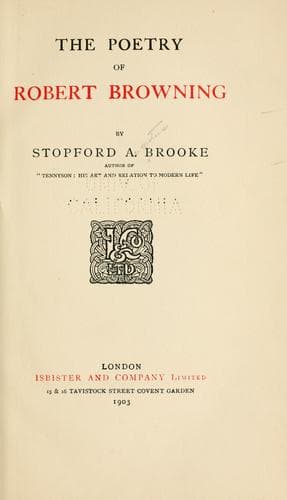
The poetry of Robert BrowningBrooke, Stopford A. (Stopford Augustus)
General
The poetry of Robert Browning
Brooke, Stopford A. (Stopford Augustus)
Browning, Robert, 1812-1889 -- Criticism and interpretation
The second motive in _Cristina_ of the lover who meets the true partner
of his soul or hers, and either seizes the happy hour and possesses joy
for ever, or misses it and loses all, is a favourite with Browning. He
repeats it frequently under diverse circumstances, for it opened out so
many various endings, and afforded so much opportunity for his beloved
analysis. Moreover, optimist as he was in his final thought of man, he
was deeply conscious of the ironies of life, of the ease with which
things go wrong, of the impossibility of setting them right from
without. And in the matter of love he marks in at least four poems how
the moment was held and life was therefore conquest. Then in _Youth and
Art_, in _Dis Aliter Visum_, in _Bifurcation_, in _The Lost Mistress_,
and in _Too Late_, he records the opposite fate, and in characters so
distinct that the repetition of the motive is not monotonous. These are
studies of the Might-have-beens of love.
Another motive, used with varied circumstance in three or four poems,
but fully expanded in _James Lee's Wife_, is the discovery, after years
of love, that love on one side is lost irretrievably. Another motive is,
that rather than lose love men or women will often sacrifice their
conscience, their reason, or their liberty. This sacrifice, of all that
makes our nobler being for the sake of personal love alone, brings with
it, because the whole being is degraded, the degradation, decay, and
death of personal love itself.
Another set of poems describes with fanciful charm, sometimes with happy
gaiety, love at play with itself. True love makes in the soul an
unfathomable ocean in whose depths are the imaginations of love,
serious, infinite, and divine. But on its surface the light of jewelled
fancies plays--a thousand thousand sunny memories and hopes, flying
thoughts and dancing feelings. A poet would be certain to have often
seen this happy crowd, and to desire to trick them out in song. So
Browning does in his poem, _In a Gondola_. The two lovers, with the dark
shadow of fate brooding over them, sing and muse and speak alternately,
imaging in swift and rival pictures made by fancy their deep-set love;
playing with its changes, creating new worlds in which to place it, but
always returning to its isolated individuality; recalling how it began,
the room where it reached its aim, the pictures, the furniture, the
balcony, her dress, all the scenery, in a hundred happy and glancing
pictures; while interlaced through their gaiety--and the gaiety made
keener by the nearness of dark fate--is coming death, death well
purchased by an hour of love. Finally, the lover is stabbed and slain,
and the pity of it throws back over the sunshine of love's fancies a
cloud of tears. This is the stuff of life that Browning loved to
paint--interwoven darkness and brightness, sorrow and joy trembling each
on the edge of the other, life playing at ball, as joyous as Nausicaa
and her maids, on a thin crust over a gulf of death.
Public-domain text, read in full here on John Shaqi.
Reviews
Reviews
No reviews yet
Be the first to share your thoughts on this work.
Elsewhere in the archive
Join the Discussion
Join the discussion
Sign in to leave a comment or review.
Sign InorCreate an account