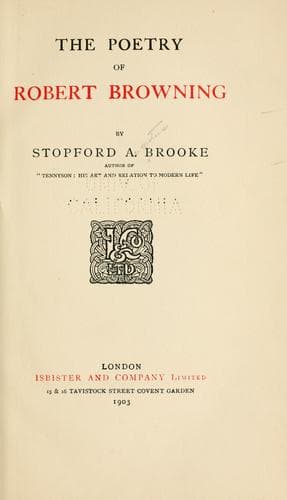
The poetry of Robert BrowningBrooke, Stopford A. (Stopford Augustus)
General
The poetry of Robert Browning
Brooke, Stopford A. (Stopford Augustus)
Browning, Robert, 1812-1889 -- Criticism and interpretation
In other poems of the evil passions the relieving element is pity. There
are the two poems entitled _Before_ and _After_, that is, before and
after the duel. _Before_ is the statement of one of the seconds, with
curious side-thoughts introduced by Browning's mental play with the
subject, that the duel is absolutely necessary. The challenger has been
deeply wronged; and he cannot and will not let forgiveness intermit his
vengeance. The man in us agrees with that; the Christian in us says,
"Forgive, let God do the judgment." But the passion for revenge has here
its way and the guilty falls. And now let Browning speak--Forgiveness is
right and the vengeance-fury wrong. The dead man has escaped, the living
has not escaped the wrath of conscience; pity is all.
Take the cloak from his face, and at first
Let the corpse do its worst!
How he lies in his rights of a man!
Death has done all death can.
And, absorbed in the new life he leads,
He recks not, he heeds
Nor his wrong nor my vengeance; both strike
On his senses alike,
And are lost in the solemn and strange
Surprise of the change.
Ha, what avails death to erase
His offence, my disgrace?
I would we were boys as of old
In the field, by the fold:
His outrage, God's patience, man's scorn
Were so easily borne!
I stand here now, he lies in his place;
Cover the face.
Again, there are few studies in literature of contempt, hatred and
revenge more sustained and subtle than Browning's poem entitled _A
Forgiveness_; and the title marks how, though the justice of revenge was
accomplished on the woman, yet that pity, even love for her, accompanied
and followed the revenge. Our natural revolt against the cold-blooded
work of hatred is modified, when we see the man's heart and the woman's
soul, into pity for their fate. The man tells his story to a monk in the
confessional, who has been the lover of his wife. He is a statesman
absorbed in his work, yet he feels that his wife makes his home a
heaven, and he carries her presence with him all the day. His wife takes
the first lover she meets, and, discovered, tells her husband that she
hates him. "Kill me now," she cries. But he despises her too much to
hate her; she is not worth killing. Three years they live together in
that fashion, till one evening she tells him the truth. "I was jealous
of your work. I took my revenge by taking a lover, but I loved you, you
only, all the time, and lost you--
I thought you gave
Your heart and soul away from me to slave
At statecraft. Since my right in you seemed lost,
I stung myself to teach you, to your cost,
What you rejected could be prized beyond
Life, heaven, by the first fool I threw a fond
Look on, a fatal word to.
Public-domain text, read in full here on John Shaqi.
Reviews
Reviews
No reviews yet
Be the first to share your thoughts on this work.
Elsewhere in the archive
Join the Discussion
Join the discussion
Sign in to leave a comment or review.
Sign InorCreate an account