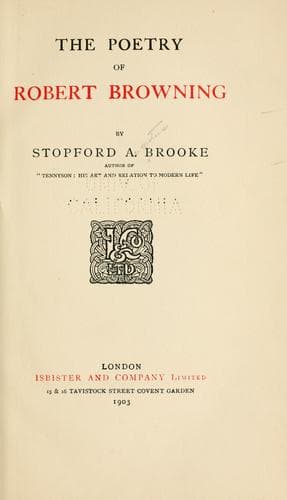
The poetry of Robert BrowningBrooke, Stopford A. (Stopford Augustus)
General
The poetry of Robert Browning
Brooke, Stopford A. (Stopford Augustus)
Browning, Robert, 1812-1889 -- Criticism and interpretation
There is some slight reason for this in Shakespeare's invention. He
lifts Caliban in intellect, even in feeling, far above Trinculo,
Stephano, the Boatswain and the rest of the common men. The objection,
however, has been made that Browning makes him too intelligent. The
answer is that Browning is not drawing Caliban only, but embodying in an
imagined personage the thoughts about God likely to be invented by early
man during thousands of years--and this accounts for the insequences in
Caliban's thinking. They are not the thoughts of one but of several men.
Yet a certain poetic unity is given to them by the unity of place. The
continual introduction of the landscape to be seen from his refuge knits
the discursive thinking of the savage into a kind of unity. We watch him
lying in the thick water-slime of the hollow, his head on the rim of it
propped by his hands, under the cave's mouth, hidden by the gadding
gourds and vines; looking out to sea and watching the wild animals that
pass him by--and out of this place he does not stir.
In Shakespeare's _Tempest_ Caliban is the gross, brutal element of the
earth and is opposed to Ariel, the light, swift, fine element of the
air. Caliban curses Prospero with the evils of the earth, with the
wicked dew of the fen and the red plague of the sea-marsh. Browning's
Caliban does not curse at all. When he is not angered, or in a caprice,
he is a good-natured creature, full of animal enjoyment. He loves to lie
in the cool slush, like a lias-lizard, shivering with earthy pleasure
when his spine is tickled by the small eft-things that course along it,
Run in and out each arm, and make him laugh.
The poem is full of these good, close, vivid realisations of the brown
prolific earth.
Browning had his own sympathy with Caliban Nor does Shakespeare make him
altogether brutish. He has been so educated by his close contact with
nature that his imagination has been kindled. His very cursing is
imaginative:
As wicked dew as e'er my mother brushed
With raven's feather from unwholesome fen
Drop on you both; a south-west blow on you
And blister you all o'er.
Stephano and Trinculo, vulgar products of civilisation, could never have
said that. Moreover, Shakespeare's Caliban, like Browning's, has the
poetry of the earth-man in him. When Ariel plays, Trinculo and Stephano
think it must be the devil, and Trinculo is afraid: but Caliban loves
and enjoys the music for itself:
Be not afear'd; the isle is full of noises,
Sounds and sweet airs, that give delight and hurt not.
Sometimes a thousand twangling instruments
Will hum about mine ears, and sometimes voices
That, if I then had waked after long sleep.
Will make me sleep again.
Stephano answers, like a modern millionaire:
This will prove a brave kingdom for me, where I shall have
my music for nothing.
Public-domain text, read in full here on John Shaqi.
Reviews
Reviews
No reviews yet
Be the first to share your thoughts on this work.
Elsewhere in the archive
Join the Discussion
Join the discussion
Sign in to leave a comment or review.
Sign InorCreate an account