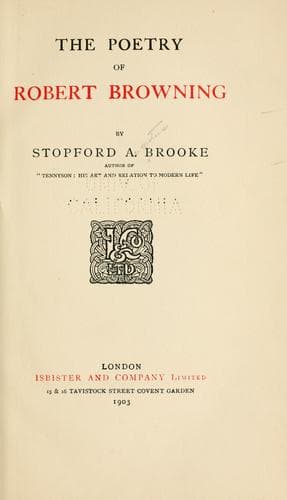
The poetry of Robert BrowningBrooke, Stopford A. (Stopford Augustus)
General
The poetry of Robert Browning
Brooke, Stopford A. (Stopford Augustus)
Browning, Robert, 1812-1889 -- Criticism and interpretation
We take a leap of more than half a century when we pass from _Fra Lippo
Lippi_ to _Andrea del Sarto_. That advance in art to which Lippo Lippi
looked forward with a kind of rage at his own powerlessness had been
made. In its making, the art of the Renaissance had painted men and
women, both body and soul, in every kind of life, both of war and peace;
and better than they had ever been painted before. Having fulfilled
that, the painters asked, "What more? What new thing shall we do? What
new aim shall we pursue?" And there arose among them a desire to paint
all that was paintable, and especially the human body, with scientific
perfection. "In our desire to paint the whole of life, we have produced
so much that we were forced to paint carelessly or inaccurately. In our
desire to be original, we have neglected technique. In our desire to
paint the passions on the face and in the movements of men, we have
lost the calm and harmony of the ancient classic work, which made its
ethical impression of the perfect balance of the divine nature by the
ideal arrangement, in accord with a finished science, of the various
members of the body to form a finished whole. Let the face no longer
then try to represent the individual soul. One type of face for each
class of art-representation is enough. Let our effort be to represent
beauty by the perfect drawing of the body in repose and in action, and
by chosen attitudes and types. Let our composition follow certain
guiding lines and rules, in accordance with whose harmonies all pictures
shall be made. We will follow the Greek; compose as he did, and by his
principles; and for that purpose make a scientific study of the body of
man; observing in all painting, sculpture, and architecture the general
forms and proportions that ancient art, after many experiments, selected
as the best. And, to match that, we must have perfect drawing in all we
do."
This great change, which, as art's adulterous connection with science
deepened, led to such unhappy results, Browning represents, when its aim
had been reached, in his poem, _Andrea del Sarto_; and he tells
us--through Andrea's talk with his wife Lucretia--what he thought of it;
and what Andrea himself, whose broken life may have opened his eyes to
the truth of things, may himself have thought of it. On that element in
the poem I have already dwelt, and shall only touch on the scenery and
tragedy, of the piece:
We sit with Andrea, looking out to Fiesole.
sober, pleasant Fiesole.
There's the bell clinking from the chapel top;
That length of convent-wall across the way
Holds the trees safer, huddled more inside;
The last monk leaves the garden; days decrease,
And autumn grows, autumn in everything.
Public-domain text, read in full here on John Shaqi.
Reviews
Reviews
No reviews yet
Be the first to share your thoughts on this work.
Elsewhere in the archive
Join the Discussion
Join the discussion
Sign in to leave a comment or review.
Sign InorCreate an account