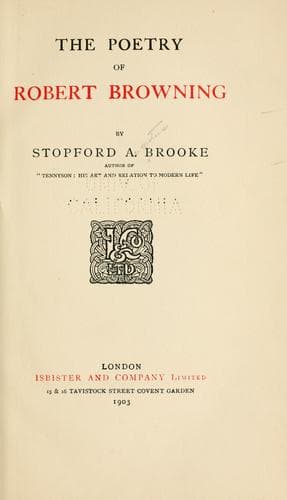
The poetry of Robert BrowningBrooke, Stopford A. (Stopford Augustus)
General
The poetry of Robert Browning
Brooke, Stopford A. (Stopford Augustus)
Browning, Robert, 1812-1889 -- Criticism and interpretation
The world of nature speaks to her and loves her. She sees all that is
beautiful, feeds on it, and grasps the matter of thought that underlies
the beauty. And so much is she at home with nature that she is able to
describe with ease in words almost as noble as the thing itself the
advent of the sun. When she leaps out of her bed to meet the leap of the
sun, the hymn of description she sings might be sung by the Hours
themselves as they dance round the car of the god. She can even play
with the great Mother as with an equal, or like her child. The charming
gaiety with which she speaks to the sunlights that dance in her room,
and to the flowers which are her sisters, prove, however isolated her
life may be, that she is never alone. Along with this brightness she has
seriousness, the sister of her gaiety; the deep seriousness of
imagination, the seriousness also of the evening when meditation broods
over the day and its doings before sleep. These, with her sweet
humanity, natural piety, instinctive purity, compose her of soft
sunshine and soft shadow. Nor does her sadness at the close, which is
overcome by her trust in God, make her less but more dear to us. She is
a beautiful creation. There are hosts of happy women like her. They are
the salt of the earth. But few poets have made so much of them and so
happily, or sung about these birds of God so well as Browning has in
_Pippa Passes_.
That was in 1841. Pleased with his success in this half-lyrical,
half-dramatic piece, he was lured towards the drama again, and also to
try his hand at those short lyrics--records of transient emotion on
fanciful subjects--or records of short but intense moments of thought or
feeling. It is a pity that he did not give to dramatic lyrics (in which
species of poetry he is quite our first master) the time he gave to
dramas, in which he is not much better than an amateur. Nevertheless, we
cannot omit the women in the dramas. I have already written of Lady
Carlisle. Polyxena, in _King Victor and King Charles_, is partly the
political woman and partly the sensible and loving wife of a strangely
tempered man. She is fairly done, but is not interesting. Good womanly
intelligence in affairs, good womanly support of her man; clear womanly
insight into men and into intrigue--a woman of whom there are hundreds
of thousands in every rank of life. In her, as in so much of Browning's
work, the intellect of the woman is of a higher quality than the
intellect of the man.
Public-domain text, read in full here on John Shaqi.
Reviews
Reviews
No reviews yet
Be the first to share your thoughts on this work.
Elsewhere in the archive
Join the Discussion
Join the discussion
Sign in to leave a comment or review.
Sign InorCreate an account