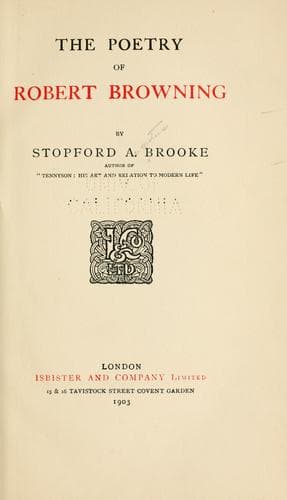
The poetry of Robert BrowningBrooke, Stopford A. (Stopford Augustus)
General
The poetry of Robert Browning
Brooke, Stopford A. (Stopford Augustus)
Browning, Robert, 1812-1889 -- Criticism and interpretation
It is not that she is naturally a dreamer, that she would not have felt
and enjoyed the realities of earth. Her perceptions are keen, her nature
expansive. Browning, otherwise, would not have cared for her. It was
only when she was involved in evil, like an angel in hell (a wolfs arm
round her throat and a snake curled over her feet), that she seemed to
be dreaming, not living. It was incredible to her that such things
should be reality. Yet even the dream called the hidden powers of her
soul into action. In realising these as against evil she is not the
dreamer. Her fortitude is unbroken; her moral courage never fails,
though she is familiar with fear; her action, when the babe has leaped
in her womb, is prompt, decisive and immediate; her physical courage,
when her husband overtakes her and befouls her honour, is like a man's.
She seizes his sword and would have slain the villain. Then, her natural
goodness, the genius of her goodness, gives her a spiritual penetration
which is more than an equivalent in her for an educated intelligence.
Her intuition is so keen that she sees through the false worldliness of
Caponsacchi to the real man beneath, and her few words call it into
goodness and honour for ever. Her clear sense of truth sees all the
threads of the net of villany in which she has been caught, and the only
means to break through it, to reveal and bring it into condemnation.
Fortitude, courage, intuition and intelligence are all made to arise out
of her natural saintliness and love. She is always the immortal child.
For a time she has passed on earth through the realms of pain; and now,
stabbed to her death, she looks back on the passage, and on all who have
been kind and unkind to her--on the whole of the falsehood and villany.
And the royal love in her nature is the master of the moment. She makes
excuses for Violante's lie. "She meant well, and she did, as I feel now,
little harm." "I am right now, quite happy; dying has purified me of the
evil which touched me, and I colour ugly things with my own peace and
joy. Every one that leaves life sees all things softened and bettered."
As to her husband, she finds that she has little to forgive him at the
last. Step by step she goes over all he did, and even finds excuses for
him, and, at the end, this is how she speaks, a noble utterance of
serene love, lofty intelligence, of spiritual power and of the
forgiveness of eternity.
Public-domain text, read in full here on John Shaqi.
Reviews
Reviews
No reviews yet
Be the first to share your thoughts on this work.
Elsewhere in the archive
Join the Discussion
Join the discussion
Sign in to leave a comment or review.
Sign InorCreate an account