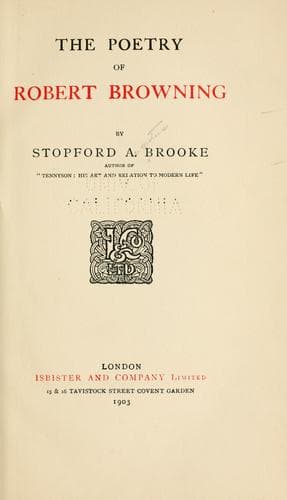
The poetry of Robert BrowningBrooke, Stopford A. (Stopford Augustus)
General
The poetry of Robert Browning
Brooke, Stopford A. (Stopford Augustus)
Browning, Robert, 1812-1889 -- Criticism and interpretation
That is her charming way. She also is, like Pompilia, young. But no
contrast can be greater than that between Pompilia at seventeen years of
age and Balaustion at fifteen. In Greece, as in Italy, women mature
quickly. Balaustion is born with that genius which has the experience of
age in youth and the fire of youth in age. Pompilia has the genius of
pure goodness, but she is uneducated, her intelligence is untrained, and
her character is only developed when she has suffered. Balaustion, on
the contrary, has all the Greek capacity, a thorough education, and that
education also which came in the air of that time to those of the
Athenian temper. She is born into beauty and the knowledge of it, into
high thinking and keen feeling; and she knows well why she thought and
how she felt. So finely wrought is she by passion and intelligence
alike, with natural genius to make her powers tenfold, that she sweeps
her kinsfolk into agreement with her, subdues the sailors to her will,
enchants the captain, sings the whole crew into energy, would have, I
believe, awed and enthralled the pirate, conquers the Syracusans,
delights the whole city, draws a talent out of the rich man which she
leaves behind her for the prisoners, is a dear friend of sombre
Euripides, lures Aristophanes, the mocker, into seriousness, mates
herself with him in a whole night's conversation, and wrings praise and
honour from the nimblest, the most cynical, and the most world-wise
intellect in Athens.
Thus, over against Pompilia, she is the image of fine culture, held back
from the foolishness and vanity of culture by the steadying power of
genius. Then her judgment is always balanced. Each thing to her has many
sides. She decides moral and intellectual questions and action with
justice, but with mercy to the wrong opinion and the wrong thing,
because her intellect is clear, tolerant and forgiving through
intellectual breadth and power. Pompilia is the image of natural
goodness and of its power. A spotless soul, though she is passed through
hell, enables her, without a trained intellect, with ignorance of all
knowledge, and with as little vanity as Balaustion, to give as clear and
firm a judgment of right and wrong. She is as tolerant, as full of
excuses for the wrong thing, as forgiving, as Balaustion, but it is by
the power of goodness and love in her, not by that of intellect.
Browning never proved his strength more than when he made these two, in
vivid contrast, yet in their depths in harmony; both equal, though so
far apart, in noble womanhood. Both are beyond convention; both have a
touch of impulsive passion, of natural wildness, of flower-beauty. Both
are, in hours of crisis, borne beyond themselves, and mistress of the
hour. Both mould men, for their good, like wax in their fingers. But
Pompilia is the white rose, touched with faint and innocent colour; and
Balaustion is the wild pomegranate flower, burning in a crimson of love
Public-domain text, read in full here on John Shaqi.
Reviews
Reviews
No reviews yet
Be the first to share your thoughts on this work.
Elsewhere in the archive
Join the Discussion
Join the discussion
Sign in to leave a comment or review.
Sign InorCreate an account