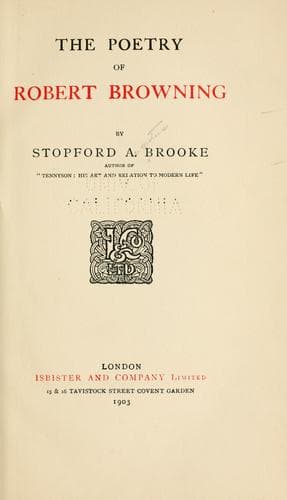
The poetry of Robert BrowningBrooke, Stopford A. (Stopford Augustus)
General
The poetry of Robert Browning
Brooke, Stopford A. (Stopford Augustus)
Browning, Robert, 1812-1889 -- Criticism and interpretation
We understand that she has drunk deep of Socrates, that her spiritual
sense reached onward to the Platonic Socrates. In this supersensuous
world of thought she is quieted out of the weakness which made her
miserable over the fall of Athens; and in the quiet, Browning, who will
lift his favourite into perfectness, adds to her spiritual imagination
the dignity of that moral judgment which the intellect of genius gathers
from the facts of history. In spite of her sorrow, she grasps the truth
that there was justice in the doom of Athens. Let justice have its way.
Let the folk die who pulled her glory down. This is her prophetic
strain, the strength of the Hebrew in the Greek.
And then the prophet in the woman passes, and the poet in her takes the
lyre. She sees the splendid sunset. Why should its extravagance of glory
run to waste? Let me build out of it a new Athens, quarry out the golden
clouds and raise the Acropolis, and the rock-hewn Place of Assembly,
whence new orators may thunder over Greece; and the theatre where
Æschylus, Sophocles, Euripides, godlike still, may contend for the
prize. Yet--and there is a further change of thought--yet that may not
be. To build that poetic vision is to slip away from reality, and the
true use of it. The tragedy is there--irrevocable. Let it sink deep in
us till we see Rhodes shining over the sea. So great, so terrible, so
piteous it is, that, dwelt on in the soul and seen in memory, it will do
for us what the great tragedians made their tragic themes do for their
hearers. It will purify the heart by pity and terror from the baseness
and littleness of life. Our small hatreds, jealousies and prides, our
petty passions will be rebuked, seem nothing in its mighty sorrow.
What else in life seems piteous any more
After such pity, or proves terrible
Beside such terror;
Public-domain text, read in full here on John Shaqi.
Reviews
Reviews
No reviews yet
Be the first to share your thoughts on this work.
Elsewhere in the archive
Join the Discussion
Join the discussion
Sign in to leave a comment or review.
Sign InorCreate an account