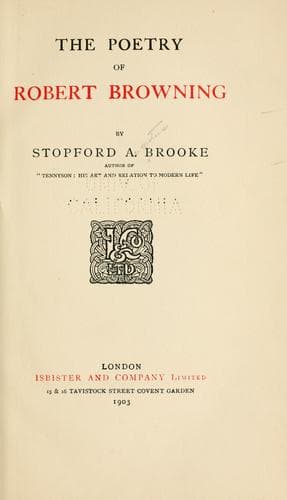
The poetry of Robert BrowningBrooke, Stopford A. (Stopford Augustus)
General
The poetry of Robert Browning
Brooke, Stopford A. (Stopford Augustus)
Browning, Robert, 1812-1889 -- Criticism and interpretation
This great length, elaborate detail, and the repetition so many times of
the same story, would naturally suggest to an intending reader that the
poem might be wearisome. Browning, suspecting this, and in mercy to a
public who does not care for a work of _longue haleine_, published it at
first in four volumes, with a month's interval between each volume. He
thought that the story told afresh by characters widely different would
strike new, if each book were read at intervals of ten days. There were
three books in each volume. And if readers desire to realise fully the
intellectual _tour de force_ contained in telling the same story twelve
times over, and making each telling interesting, they cannot do better
than read the book as Browning wished it to be read. "Give the poem four
months, and let ten days elapse between the reading of each book," is
what he meant us to understand. Moreover, to meet this possible
weariness, Browning, consciously, or probably unconsciously, since
genius does the right thing without asking why, continually used a trick
of his own which, at intervals, stings the reader into wakefulness and
pleasure, and sends him on to the next page refreshed and happy. After
fifty, or it may be a hundred lines of somewhat dry analysis, a vivid
illustration, which concentrates all the matter of the previous lines,
flashes on the reader as a snake might flash across a traveller's dusty
way: or some sudden description of an Italian scene in the country or in
the streets of Rome enlivens the well-known tale with fresh humanity. Or
a new character leaps up out of the crowd, and calls us to note his
ways, his dress, his voice, his very soul in some revealing speech, and
then passes away from the stage, while we turn, refreshed (and indeed at
times we need refreshment), to the main speaker, the leading character.
Public-domain text, read in full here on John Shaqi.
Reviews
Reviews
No reviews yet
Be the first to share your thoughts on this work.
Elsewhere in the archive
Join the Discussion
Join the discussion
Sign in to leave a comment or review.
Sign InorCreate an account