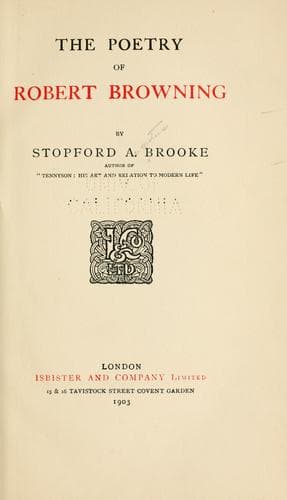
The poetry of Robert BrowningBrooke, Stopford A. (Stopford Augustus)
General
The poetry of Robert Browning
Brooke, Stopford A. (Stopford Augustus)
Browning, Robert, 1812-1889 -- Criticism and interpretation
O lyric Love, half angel and half bird
And all a wonder and a wild desire,--
Boldest of hearts that ever braved the sun,
Took sanctuary within the holier blue,
And sang a kindred soul out to his face,--
Yet human at the red-ripe of the heart--
When the first summons from the darkling earth
Reached thee amid thy chambers, blanched their blue,
And bared them of the glory--to drop down,
To toil for man, to suffer or to die,--
This is the same voice: can thy soul know change
Hail then, and hearken from the realms of help!
Never may I commence my song, my due
To God who best taught song by gift of thee,
Except with bent head and beseeching hand--
That still, despite the distance and the dark,
What was, again may be; some interchange
Of grace, some splendour once thy very thought,
Some benediction anciently thy smile:
--Never conclude, but raising hand and head
Thither where eyes, that cannot reach, yet yearn
For all hope, all sustainment, all reward,
Their utmost up and on,--so blessing back
In those thy realms of help, that heaven thy home,
Some whiteness which, I judge, thy face makes proud,
Some wanness where, I think, thy foot may fall!
The poem begins with the view that one half of Rome took of the events.
At the very commencement we touch one of the secondary interests of the
book, the incidental characters. Guido, Caponsacchi, Pompilia, the Pope,
and, in a lesser degree, Violante and Pietro, are the chief characters,
and the main interest contracts around them. But, through all they say
and do, as a motley crowd through a street, a great number of minor
characters move to and fro; and Browning, whose eye sees every face, and
through the face into the soul, draws them one by one, some more fully
than others in perhaps a hundred lines, some only in ten. Most of them
are types of a class, a profession or a business, yet there is always a
touch or two which isolates each of them so that they do not only
represent a class but a personal character. He hated, like Morris, the
withering of the individual, nor did he believe, nor any man who knows
and feels mankind, that by that the world grew more and more. The poem
is full of such individualities. It were well, as one example, to read
the whole account of the people who come to see the murdered bodies laid
out in the Church of Lorenzo. The old, curious, doddering gossip of the
Roman street is not less alive than the Cardinal, and the clever pushing
Curato; and around them are heard the buzz of talk, the movement of the
crowd. The church, the square are humming with humanity.
Public-domain text, read in full here on John Shaqi.
Reviews
Reviews
No reviews yet
Be the first to share your thoughts on this work.
Elsewhere in the archive
Join the Discussion
Join the discussion
Sign in to leave a comment or review.
Sign InorCreate an account