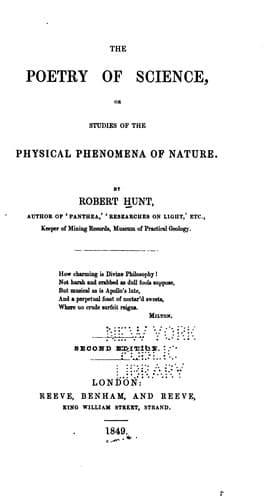
The Poetry of Science; or, Studies of the Physical Phenomena of NatureHunt, Robert
Philosophy
The Poetry of Science; or, Studies of the Physical Phenomena of Nature
Hunt, Robert
Physics; Science
[71] _On the Effect of Heat in lessening the affinities of the Elements
of Water_: by the Rev. Thomas Romney Robinson, D.D.--Transactions of
the Royal Irish Academy, vol. xxi. part 2.
[72] _An Inquiry concerning the Chemical Properties that have been
attributed to Light_: by Benjamin, Count of Rumford.--Philosophical
Transactions, vol. lxxxviii. p. 449.--The results obtained by Count
Rumford were probably due to the non-luminous heat-rays--parathermic
rays--which are known to be given off by boiling water.
[73] For Dr. Drapers paper, see Philosophical Magazine for May, 1847,
vol. xxx. 3rd series.
[74] _On the Action of the Rays of the Solar Spectrum on Vegetable
Colours_: by Sir J. F. W. Herschel, Bart.
The proof of the continuation of the visible prismatic spectrum beyond
the extreme violet may be witnessed in the following manner:--“Paper
stained with tincture of turmeric is of a yellow colour; and, in
consequence, the spectrum thrown in it, if exposed in open daylight,
is considerably affected in its apparent colours, the blue portion
appearing violet, and the violet very pale and faint; but beyond the
region occupied by the violet rays, is distinctly to be seen a faint
prolongation of the spectrum, terminated laterally, like the rest of
it, by straight and sharp outlines, and which, in this case, affects
the eye with the sensation of a pale yellow colour.”--Philosophical
Transactions, p. 133.
[75] The most complete exposition of the theory that animal heat is
derived from chemical action only, will be found in _Animal Chemistry,
or Chemistry in its applications to Physiology and Pathology_, by
Justus Liebig: translated by Dr. Gregory. The conclusions arrived at
by the author, notwithstanding his high--and deservedly high--position
in chemical science, must, however, be received with great caution,
many of them being founded on most incorrect premises, and his
generalizations being of the most hasty and imperfect character. At
page 22 the following passage occurs:--“If we were to go naked, like
certain savage tribes, or if in hunting or fishing we were exposed
to the same degree of cold as the Samoiedes, we should be able, with
ease, to consume ten pounds of flesh, and, perhaps, a dozen of tallow
candles into the bargain, daily, as warmly clad travellers have related
with astonishment of these people. We should then also be able to take
the same quantity of brandy or train-oil without bad effects, because
the carbon and hydrogen of these substances would only suffice to keep
up the equilibrium between the external temperature and that of our
bodies.”
A brief examination will exhibit the error of this. The analysis of
Beef, by D. Lyon Playfair, is as follows:--
Carbon 51·83
Hydrogen 7·57
Nitrogen 15·01
Oxygen 21·37
Ashes 4·23
And the following has been given by Chevreul as the composition of
mutton tallow:--
Carbon 96
Hydrogen 16
Nitrogen 16
Oxygen 48
Public-domain text, read in full here on John Shaqi.
Reviews
Reviews
No reviews yet
Be the first to share your thoughts on this work.
Elsewhere in the archive
Join the Discussion
Join the discussion
Sign in to leave a comment or review.
Sign InorCreate an account