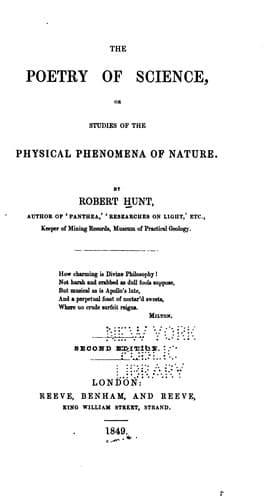
The Poetry of Science; or, Studies of the Physical Phenomena of NatureHunt, Robert
Philosophy
The Poetry of Science; or, Studies of the Physical Phenomena of Nature
Hunt, Robert
Physics; Science
Indeed, the attentive study of the fine abstractions of science lifts
the mind from the grossness of matter, step by step, to the refinements
of immateriality, and there appear, shadowed out beyond the physical
forces which man can test and try, other powers still ascending, until
they reach the Source of every good and every perfect gift.
FOOTNOTES:
[84] “These--oxygen, hydrogen, nitrogen, and carbon--are the four
bodies, in fact, which, becoming animated at the fire of the sun,
the true torch of Prometheus, approve themselves upon the earth
the eternal agents of organisation, of sensation, of motion and of
thought.”--Dumas, _Leçons de Philosophie Chimique_, p. 100. Paris, 1837.
[85] It will be found in examining any of the works of the
alchemists,--particularly those of Geber, _De inveniendi arte Auri et
Argenti_, and his _De Alchemiâ_; Roger Bacon’s _Opus Majus, or Alchymia
Major_; Helvetius’ _Brief of the Golden Calf_; or Basil Valentine’s
_Currus Triumphalis_,--that in the processes of transmutation the solar
light was supposed to be marvellously effective. In Boyle’s _Sceptical
Chemist_ the same idea will be found pervading it.
Amid all their errors, the alchemists were assiduous workmen, and to
them we are indebted for numerous facts. Of them, and of their age, as
contrasted with our own, Gibbon remarks:--“Congenial to the avarice
of the human heart, it was studied in China, as in Europe, with equal
eagerness and equal success. The darkness of the middle ages ensured
a favourable reception to every tale of wonder; and the revival of
learning gave new vigour to hope, and suggested more specious arts
of deception. Philosophy, with the aid of experience, has at length
banished the study of alchemy; and the present age, however desirous of
riches, is content to seek them by the humbler means of commerce and
industry.”--_Decline and Fall_, vol. ii. p. 137.
[86] On the two theories the following maybe consulted:--Young,
_Supplement to Encyclopædia Britannica_, article _Chromatics_;
Fresnel, _Supplément à la Traduction Française de la 5ième édition du
Traité de Chimie de Thomson_, par Riffault, Paris, 1822; Herschel’s
Article, _Light_, in the Encyclopædia Metropolitana, and the French
Translation of it by Quetelet and Verhulst; Airy’s _Tract on the
Undulatory Theory_, in his Tracts, 2nd edition, Cambridge, 1831; Powel,
_The Undulatory Theory applied to Dispersion_, &c. p. 184; Lloyd’s
_Lectures_, Dublin, 1836-41; Cauchy, _Sur le Mouvement des Corps
élastiques_, Mémoires de l’Institut, 1827, vol. ix. p. 114; _Théorie de
la Lumière_, Ibid. vol. x. p. 293; M’Cullagh, _On Double Refraction_,
Ibid., vol. xvi.; _Geometrical Propositions applied to the Wave Theory
of Light_, Ibid., vol. xvii.; Sir David Brewster’s papers in the
Transactions of the Royal Society of Edinburgh, and the Philosophical
Magazine.
Public-domain text, read in full here on John Shaqi.
Reviews
Reviews
No reviews yet
Be the first to share your thoughts on this work.
Elsewhere in the archive
Join the Discussion
Join the discussion
Sign in to leave a comment or review.
Sign InorCreate an account