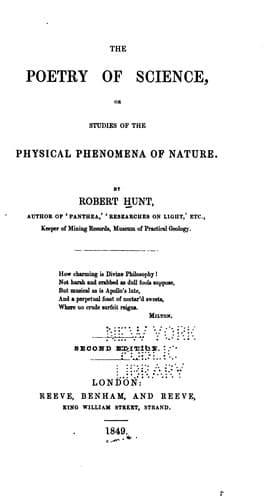
The Poetry of Science; or, Studies of the Physical Phenomena of NatureHunt, Robert
Philosophy
The Poetry of Science; or, Studies of the Physical Phenomena of Nature
Hunt, Robert
Physics; Science
We have evidence which appears to prove that this chemical agent may
be absorbed by simple bodies, and that by this absorption an actual
change of condition, is produced, in many respects analogous to those
allotropic changes which we have previously considered. Chlorine, in
its ordinary state, does not combine with hydrogen in the dark. If we
employ the yellow medium of chlorine gas, for the purpose of analyzing
the sun’s rays previously to their falling upon some chemical compound
which is sensitive to actinic power, we shall find that the chlorine
obstructs all this actinism, and, however unstable the compound,
it remains unchanged. But the chlorine gas which has interrupted
this wonderful agent, appears to have absorbed it, and it is so far
altered in its constitution that _it will unite with hydrogen in the
dark_.[120] In like manner, if, of two portions of the same solution
of sulphate of iron, one is kept in the dark and the other exposed
to the sunshine, it will be found that the solution which has been
exposed will precipitate gold and silver from their combinations much
more speedily than that which has been preserved in darkness--the
temperature and every other condition being the same.
The phenomena of the Daguerreotype involve many strange conditions.
A plate of silver, on which a slight chemical action has been
established by the use of iodine, is exposed to the lenticular image
in the camera obscura. If allowed to remain under the influence of
these radiations for a sufficient length of time, a faithful picture
of the illuminated objects is delineated on the plate, as shown by
the visible decomposition and darkening of the iodized surface. The
plate is not, however, in practice allowed to assume this condition;
after an exposure of a few seconds the radiant influence is cut off,
and the eye cannot detect any evidence of change upon the yellow
plate. It is now exposed to the vapour of mercury, and that metal in
a state of exceedingly fine division is condensed upon the plate;
but the condensation is not uniformly spread upon its face. The
deposit of mercurial vapour is in exact proportion to the amount of
chemical action produced. Is the change, by which this peculiar power
of condensation is effected, a chemical, calorific, electrical, or
merely a molecular one? The evidences, at present, are not sufficient
to determine the question. It has lately been suggested, that the
mercury acts chemically only, and effects the full decomposition of
the iodide of silver; and that the picture is due to this, and not to
the deposition actually of the mercury vapour. In all probability we
have the involved action of several forces. We have some experiments
which show, clearly enough, that mercury is deposited in proportions
which correspond with the intensity of solar action. A chemically
prepared surface is not necessary to exhibit this result. A polished
plate of metal, of glass, of marble, or a piece of painted wood, being
Public-domain text, read in full here on John Shaqi.
Reviews
Reviews
No reviews yet
Be the first to share your thoughts on this work.
Elsewhere in the archive
Join the Discussion
Join the discussion
Sign in to leave a comment or review.
Sign InorCreate an account