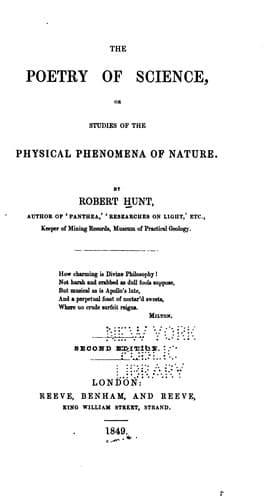
The Poetry of Science; or, Studies of the Physical Phenomena of NatureHunt, Robert
Philosophy
The Poetry of Science; or, Studies of the Physical Phenomena of Nature
Hunt, Robert
Physics; Science
Experiments with the spectrum have been made in different latitudes,
and it is found, that, as we proceed towards the equator, a band which
is always left unchanged, corresponding exactly with the rays of
greatest illuminating power, regularly enlarges in size, thus proving
the increase of light over actinism--and the interfering power of the
former.
By increasing the sensibility of the photographic preparation, this
difficulty is overcome, and particularly when any organic compound
enters into the preparation. So that we are now enabled to copy nature
in all her varying moods, whether we employ our photographic tablets in
temperate Europe, or in tropical Africa.
The degree of sensibility which has been attained is remarkable. Mr.
Fox Talbot, by uniting a process devised by Dr. Woods, of Parsonstown,
and another which was first introduced by the author of this volume,
and combining them with an ether, obtains a most unstable compound,
which he thus employs. A glass plate is covered with albumen united
with the above solution, and then with nitrate of silver: this forms
the sensitive surface. The plate being placed in the dark, in a camera,
it is so adjusted that the image of a printed bill fixed upon a wheel
may fall upon it when uncovered, and the wheel illuminated. The wheel
is made to revolve with the utmost rapidity, in a perfectly dark
room, and the sensitive plate uncovered. Then the whirling bill is
illuminated for an inappreciably short space of time by the discharge
of a Leyden jar. Notwithstanding the rapid rate at which the pointed
paper is moving, and the instantaneous nature of the illumination--a
miniature flash of lightning--the bill is found to be copied with
unfailing fidelity upon the photographic plate. It unfortunately
happens, that the preparation by which this extraordinary degree of
sensibility is obtained, is very uncertain in its action--and hence it
is not generally useful; but here we have the evidence to show that
at a speed as rapid as that of a rifle-ball an impression may be made
upon a photographic plate. There are, however, some new processes which
promise eventually to rival the above for sensibility, and to be by no
means of difficult manipulation. Of this character is the collodion
process. The gun cotton dissolved in ether possesses some very great
accelerating properties, and in combination with the silver salts, and
one of the vegetable acids, it forms a sensitive surface upon which
pictures may be obtained in less than a second of time.
Public-domain text, read in full here on John Shaqi.
Reviews
Reviews
No reviews yet
Be the first to share your thoughts on this work.
Elsewhere in the archive
Join the Discussion
Join the discussion
Sign in to leave a comment or review.
Sign InorCreate an account