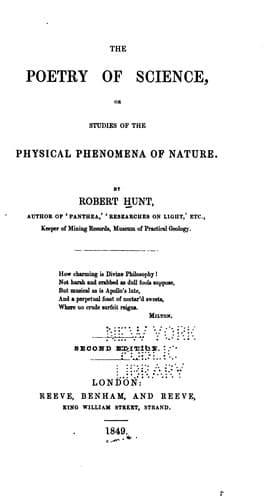
The Poetry of Science; or, Studies of the Physical Phenomena of NatureHunt, Robert
Philosophy
The Poetry of Science; or, Studies of the Physical Phenomena of Nature
Hunt, Robert
Physics; Science
If an inquiring mind had not been led to ask why does this curious
natural production attract a feather, the present age, in all
probability, would not have been in possession of the means by which it
is enabled to transmit intelligence with a rapidity which equals the
poet’s dream of the “swift-winged messengers of thought.” To this age
of application a striking lesson does this amber teach. Modern utility
would have regarded Thales as a madman. Holding a piece of yellow
resin in his hand, rubbing it, and then picking up bits of down, or
catching floating feathers, the old Greek would have appeared a very
imbecile, and the _cui bono_ generation would have laughed at his silly
labours. But when he announced to his school that this amber held a
soul or essence, which was awakened by friction, and went forth from
the body in which it previously lay dormant, and brought back the small
particles floating around it, he gave to the world the first hint of
a great truth which has advanced our knowledge of physical phenomena
in a marvellous manner, and ministered to the refinements and to the
necessities of civilisation. Each phenomenon which presents itself to
us, however simple it may appear to be, is an outward expression of
some internal truth, the interpretation of which is only to be arrived
at by assiduous study, but which, once discovered, directs the way to
new knowledge, and gives to man a great increase of power. There is no
truth so abstract that it will not find its useful application, and
every example of the ministration of Physical Science to the purposes
of humanity is an evidence of the value of abstract study, and a reply
to the utilitarian in his own language.
Electricity appears to be diffused through all nature; and it is,
beyond all doubt, one of the most important of the physical forces, in
the great phenomena of creation. In the thunder-cloud, swelling with
destruction, it resides, ready to launch its darts and shake the earth
with its explosions: in the aërial undulations, silent and unseen, it
passes, giving the necessary excitement to the organisms around which
it floats. The rain-drop--the earth-girdling ocean--and the ringing
waters of the hill-born river, hold locked this mighty force. The
solid rocks--the tenacious clays which rest upon them--the superficial
soils--and the incoherent sands, give us evidence of the presence of
this agency; and in the organic world, whether animal or vegetable, the
excitement of electrical force is always to be detected.
In the solar radiations we have perhaps the prime mover of this
power. In our atmosphere, when calm and cloudless, a great ocean of
light, or when sombre with the mighty aspect of the dire tornado, we
can constantly detect the struggle between the elements of matter to
maintain an equilibrium of electrical force.
Public-domain text, read in full here on John Shaqi.
Reviews
Reviews
No reviews yet
Be the first to share your thoughts on this work.
Elsewhere in the archive
Join the Discussion
Join the discussion
Sign in to leave a comment or review.
Sign InorCreate an account