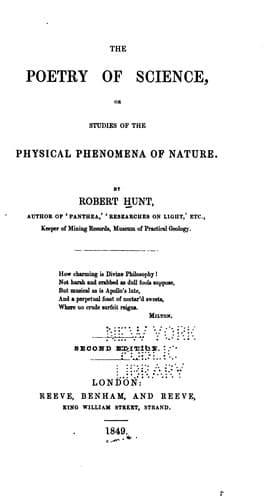
The Poetry of Science; or, Studies of the Physical Phenomena of NatureHunt, Robert
Philosophy
The Poetry of Science; or, Studies of the Physical Phenomena of Nature
Hunt, Robert
Physics; Science
We can only understand this upon the supposition that a series of
impulses are communicated in the most rapid manner along the connecting
line; the idea of a current, although the term is commonly employed,
tends to convey an imperfect impression to the mind. It would seem
rather that a disturbance throughout the entire circuit is at once set
up by a series of vibrations or impulses communicated from particle to
particle, and along the strange net-work of nerves. One set of chemical
elements have a tendency to develope themselves at that point where
vibration is first communicated to the mass from a better conductor
than it is, and another set at the point where it passes from the
body to a better conductor than itself. The cause of this is to be
sought for in the laws which regulate molecular constitution--by which
chemical affinity is disturbed,--and a new attractive force exerted,
in obedience to which the vital energy is itself agitated. We must
not, however, forget that it is probable after all, although not yet
susceptible of proof, that the electricity does nothing more than
disturb or quicken the unknown principles upon which chemical and vital
phenomena depend; being, indeed, a secondary agent.[141]
Notwithstanding our long acquaintance with the phenomena of galvanism,
there are but few who entertain a correct idea of the enormous amount
of electricity which is necessary to the existing conditions of matter.
To Faraday we are indebted for the first clear set of deductions from a
series of inductive researches, which are of the most complete order.
He has proved, by a series of exceedingly conclusive experiments, that
if the electrical power which holds a grain of water in combination,
or which causes a grain of oxygen and hydrogen to unite in the right
proportions to form water, could be collected and thrown into the
condition of a voltaic current, it would be exactly the quantity
required to produce the decomposition of that grain of water, or the
liberation of its elements, hydrogen and oxygen.[142]
By direct experiment it has been proved that one equivalent of zinc in
a voltaic arrangement evolves such a quantity of electricity in the
form of a current, as, passing through water, will decompose exactly
one equivalent of that fluid. The law has been thus expressed:--The
electricity which decomposes, and that which is evolved by the
decomposition of a certain quantity of matter, are alike. The
equivalent weights of bodies are those quantities of them which contain
equal quantities of electricity; electricity determining the equivalent
number, because it determines the combining force.[143]
Public-domain text, read in full here on John Shaqi.
Reviews
Reviews
No reviews yet
Be the first to share your thoughts on this work.
Elsewhere in the archive
Join the Discussion
Join the discussion
Sign in to leave a comment or review.
Sign InorCreate an account