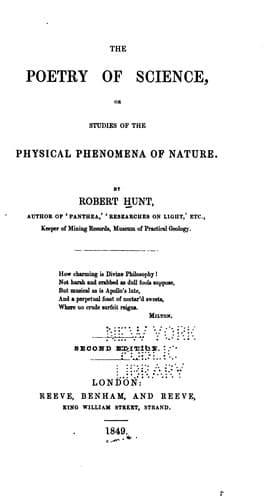
The Poetry of Science; or, Studies of the Physical Phenomena of NatureHunt, Robert
Philosophy
The Poetry of Science; or, Studies of the Physical Phenomena of Nature
Hunt, Robert
Physics; Science
The phenomenon of thermo-electricity--the discovery of Seebeck, is
another proof of the very close connection of the physical forces. We
witness their being resolved as it were into each other, electricity
producing heat, and heat again electricity; and it is from these
curious results that the arguments in favour of their intimate
relations and actual identity have been drawn. It will, however, be
found to be the best philosophy to regard these forces as dissimilar,
until we are enabled to prove them to be only modified forms of one
principle or power. At the same time it must not be forgotten that
in natural operations we invariably find the combined action of
several forces producing a single phenomenon. The important fact to be
particularly regarded is, that we have evidence that every substance
which is unequally heated becomes the source of this very remarkable
form of electricity.[148]
There exist a few fishes gifted with the very extraordinary power of
producing electrical phenomena by an effort of muscular or nervous
energy.
The _Gymnotus electricus_, or electrical eel, and the _Raia torpedo_,
a species of ray, are the most remarkable. This power is, it would
appear, given to these curious creatures for purposes of defence, and
also for enabling them to secure their prey. The _Gymnotus_ of the
South America rivers, will, it is said, when in full vigour, send forth
a discharge of electricity sufficiently powerful to knock down a man,
or to stun a horse; while it can destroy fishes, through a considerable
space, by exerting its strange artillery.[149]
Faraday’s description of a _Gymnotus_, paralyzing and seizing its
prey, is too graphic and important to be omitted.
Public-domain text, read in full here on John Shaqi.
Reviews
Reviews
No reviews yet
Be the first to share your thoughts on this work.
Elsewhere in the archive
Join the Discussion
Join the discussion
Sign in to leave a comment or review.
Sign InorCreate an account