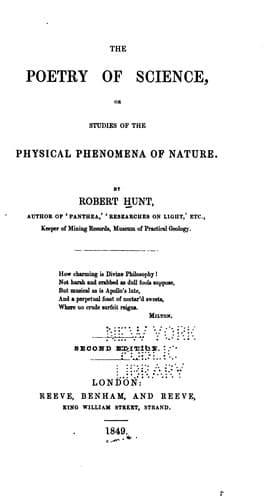
The Poetry of Science; or, Studies of the Physical Phenomena of NatureHunt, Robert
Philosophy
The Poetry of Science; or, Studies of the Physical Phenomena of Nature
Hunt, Robert
Physics; Science
The phenomena of vitality have, by many, been considered as immediately
dependent upon its influence; and a rather extensive series of
experiments has been made in support of this hypothesis. The researches
of Philip on the action of the organs of digestion, when separated
from their connection with the brain, but united with a galvanic
battery, have been proved by Dr. Reid to be delusive;[153] since, as
the organ is not removed from the influence of the living principle,
it is quite evident that the electricity here is only secondary to
some more important power. Matteucci has endeavoured to show that
nervous action is intimately connected with electric excitation, and
that electricity may be made a measurer of nervous irritability.[154]
There can be no doubt that a peculiar susceptibility to excitement
exists in some systems, and this is very strikingly shown in the
disturbances produced by electric action; but in the experiments which
have been brought forward we have only the evidence that a certain
number of muscular contractions are exhibited in one animal by a
current of electricity, giving a measured effect by the voltameter,
which are different from those produced upon another by a current of
the same power. An attempt has recently been made by Mr. A. Smee to
reduce the electrical phenomena connected with vitality to a more
exact system than had hitherto been done. We cannot, however, regard
the attempt as successful. The author has trusted almost entirely
to analogical reasoning, which is in science always dangerous.[155]
In the development of electricity during the operation of the vital
force, we see only the phenomena produced by the action of any two
dissimilar chemical compounds upon each other. It has been thought
that the structure of the brain presents an analogy to that of the
galvanic battery, and the nerves represent the conducting wires.
Although, however, some of the conditions appear similar, there are
many which have no representatives in either the mechanical structure
or the physical properties of the brain, so far as we know it. That
the brain is the centre, the source, and termination of sensation is
very clearly proved by physiological investigations. That the nerves
are the media by which all sensation is conveyed to the brain, and
also the instruments by which the will exerts its power over the
muscles, is equally well established. But to say that we have any
evidence to support the idea that electricity has aught to do directly
with these great physiological phenomena, would be a bold assertion,
betraying a want of due caution on the part of the investigator. That
electric effects are developed during the operations of vitality is
most certain. Such must be the case, from the chemical changes taking
place during respiration and digestion, and the mechanical movements
by which, even during external repose, the necessary functions of the
body are carried on. Whether electricity is the cause of these, or an
Public-domain text, read in full here on John Shaqi.
Reviews
Reviews
No reviews yet
Be the first to share your thoughts on this work.
Elsewhere in the archive
Join the Discussion
Join the discussion
Sign in to leave a comment or review.
Sign InorCreate an account