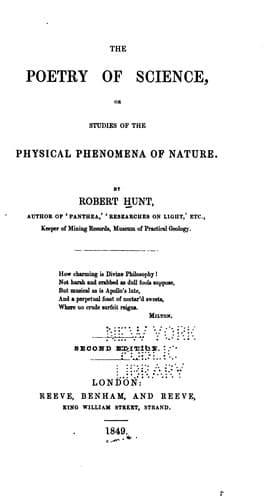
The Poetry of Science; or, Studies of the Physical Phenomena of NatureHunt, Robert
Philosophy
The Poetry of Science; or, Studies of the Physical Phenomena of Nature
Hunt, Robert
Physics; Science
The rocks, taken as masses, will not conduct an electric current when
dry: granite, porphyry, slate, and limestone, obstructing its passage
even through the smallest spaces. But all the metallic formations admit
of its circulating with great freedom. This fact it must, however,
be remembered does not in any way interfere with the hypothesis of
the existence of electricity in all bodies, in what we must regard as
its latent state, from which, under prescribed conditions, it may be
readily liberated. Neither does it affect the question of circulation,
in relation to the great diffusion of electricity which we suppose to
exist through all nature, and to move in obedience to some fixed law.
We know that through the superficial strata electric currents circulate
freely, whether they are composed of clay, sand, or any mixture of
these with decomposed organic matter; indeed, that with any substance
in a moist state they suffer no interruption.
The electricity of mineral veins has attracted much attention, and
numerous investigations into the phenomena which these metalliferous
formations present, have been made from time to time.[157]
By inserting into the mass of a copper _lode_, or vein, in situ, a
metallic wire, which shall be connected with a measurer of galvanic
action, a wire also from the instrument being brought into contact with
another _lode_, an immediate effect is generally produced, showing
that a current is traversing through the wires from one _lode_ to the
other, and completing the circulation probably over the dark face of
the rock in which the fissures forming the mineral veins exist.[158]
The currents thus detected are often sufficiently active to deflect
a magnetic needle powerfully, to produce, slowly, electro-chemical
decomposition, and to render a bar of iron magnetic. These currents
must not be confounded with the great electrical movements around the
earth. They are only to be detected in those mineral formations in
which there is evidence of chemical action going on, and, the greater
the amount of this chemical operation, the more energetic are the
electrical currents.[159] We have, however, very good evidence that
these local currents have, of themselves, many peculiar influences. It
not unfrequently happens that owing to some great disturbance of the
crust of the earth, a mineral vein is dislocated, and one part either
sinks below, or is lifted above its original position; the fissures
formed between the two being usually filled in with clay or with
crystalline masses of more recent formation than the fissure itself. It
is frequently found that these “_cross courses_,” as they are called in
mining language, contain ores of a different character from those which
constitute the mineral vein; for instance, in them nickel, cobalt, and
silver are not unfrequently discovered. When these metals are so found,
they almost invariably occur between the ends of the dislocated lode,
Public-domain text, read in full here on John Shaqi.
Reviews
Reviews
No reviews yet
Be the first to share your thoughts on this work.
Elsewhere in the archive
Join the Discussion
Join the discussion
Sign in to leave a comment or review.
Sign InorCreate an account