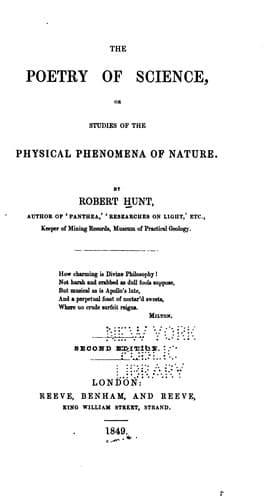
The Poetry of Science; or, Studies of the Physical Phenomena of NatureHunt, Robert
Philosophy
The Poetry of Science; or, Studies of the Physical Phenomena of Nature
Hunt, Robert
Physics; Science
Agreeably with the view now generally received, that magnetism and
electricity are but modifications of one force, since they are found to
stand to each other in the relation of cause and effect, the separation
which is here adopted, of the consideration of their several phenomena,
may appear inappropriate. The importance, however, of all that is
connected with magnetism, and the very decided difference which is
presented by true magnetic action, and that of frictional or chemical
electricity, is so great that it has been thought advantageous to adopt
the present arrangement in reviewing the influence of terrestrial
magnetism with which science has made us acquainted.
From a very early period a peculiar attractive force has been observed
in some specimens of iron ore. Masses of this kind were found in
Magnesia, and from that locality we derive the name given to iron in
its polar condition. This is confirmed by the following lines by
Lucretius:--
Quod superest agere incipiam, quo fœdere fiat
Natura lapis hic ut ferrum ducere possit,
Quem magnêta vocant patrio de nomine Graii
Magnêtum, quia sit patriis in finibus ortus.
Again we find Pliny employing the term _magnetic_, to express this
singular power. It was known to the ancients that the magnetic power
of iron, and the electric property of amber, were not of the same
character, but they were both alike regarded as miraculous. The Chinese
and Arabians seem to have known Magnetism at a period long before
that at which Europeans became acquainted with either the natural
loadstone or the artificial magnet. Previously to A.D. 121, the magnet
is distinctly mentioned in a Chinese dictionary; and in A.D. 419 it
is stated in another of their books that ships were steered south by
it.[170]
The earliest popularly received account of its use in Europe is, that
Vasco de Gama employed a compass in 1427, when that really adventurous
navigator first explored the Indian seas. It is highly probable,
however, that the knowledge of its important use was derived from some
of the Oriental nations at a much earlier period.
We have some curious descriptions of the _leading stone_ or loadstone,
in the works of an Icelandic historian, who wrote in 1068. The
mariner’s compass is described in a French poem of the date of 1181;
and from Torfæus’s History of Norway, it appears to have been known to
the northern nations certainly in 1266.
We have not to deal with the history of magnetic discovery, but so
far as it tells of the strange properties which magnets are found to
possess, and the application of this knowledge to the elucidation of
effects occurring in nature.
Public-domain text, read in full here on John Shaqi.
Reviews
Reviews
No reviews yet
Be the first to share your thoughts on this work.
Elsewhere in the archive
Join the Discussion
Join the discussion
Sign in to leave a comment or review.
Sign InorCreate an account