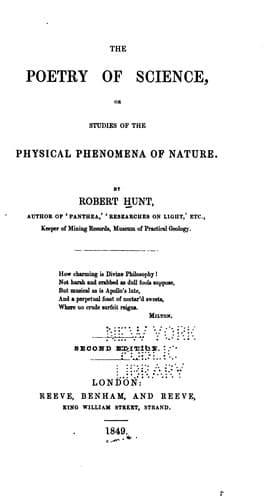
The Poetry of Science; or, Studies of the Physical Phenomena of NatureHunt, Robert
Philosophy
The Poetry of Science; or, Studies of the Physical Phenomena of Nature
Hunt, Robert
Physics; Science
The above terms are exceedingly near 864, 1246, 1728, 4320, and those
numbers are equal to the mystic number of the Indians, Greeks, and
Egyptians, 432 multiplied by 2, 3, 4, and 10. On these the ancients
believed a certain combination of natural events to depend, and,
according to Brahminical mythology, the duration of the world is
divided into four periods, each of 432,000 years. Again, the sun’s mean
distance from the earth is 216 radii of the sun, and the moon’s mean
distance 216 radii of the moon, each the half of 432. Proceeding with
this very curious examination, Hansteen says, 60 multiplied by 432
equals 15,920, the smallest number divisible at once by all the four
periods of magnetic revolution, and hence the shortest time in which
the four poles can complete a cycle, and return to their present state,
and _which coincides exactly with the period in which the precession
of the equinoxes will amount to a complete circle_, reckoning the
precession at a degree in seventy-two years.[176]
When we consider the phenomena of terrestrial magnetism carefully, it
appears to indicate the action of a power external to the earth itself,
and, as Hansteen conceives, having its origin from the action of the
sun, heating, illuminating, and producing a magnetic tension, in the
same manner as it produces electrical excitation and actino-chemical
action.
The movements of these magnetic poles have been the subject of
extensive and most accurate observation in every quarter of the globe.
In London, during 1657-1662, there was no magnetic variation; the
agonic line passing through it. The variation steadily increased,
until, in 1815, it amounted to 24° 15' 17", since which time it has
been slowly diminishing. In addition to this great variation, we
have a regular annual change dependent on the position of the sun,
in reference to the equinoctial and solstitial points, which was
discovered by Cassini, and investigated by Arago and others. Also a
diurnal variation, which movement appears to commence early in the
morning, moving eastward until half-past seven, A.M., when it begins
to move westward until two, P.M., when it again returns to the east,
and in the course of the night reaches the point from which it started
twenty-four hours before.
We have also remarkable variations in what is termed the _dip_ of
the needle. It is well known that a piece of unmagnetized steel, if
carefully suspended by its centre, will swing in a perfectly horizontal
position, but, if we magnetize this bar, it will immediately be drawn
downwards at one end. The force of the earth’s polarity, attracting the
dissimilar pole, has caused it to _dip_.
Public-domain text, read in full here on John Shaqi.
Reviews
Reviews
No reviews yet
Be the first to share your thoughts on this work.
Elsewhere in the archive
Join the Discussion
Join the discussion
Sign in to leave a comment or review.
Sign InorCreate an account