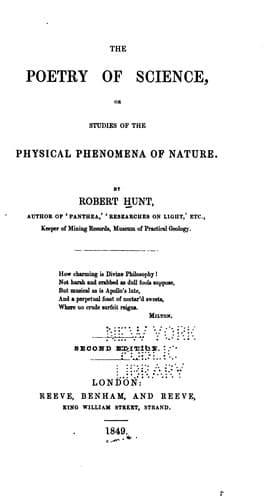
The Poetry of Science; or, Studies of the Physical Phenomena of NatureHunt, Robert
Philosophy
The Poetry of Science; or, Studies of the Physical Phenomena of Nature
Hunt, Robert
Physics; Science
[186] Those bodies which are attracted by a magnet, as iron is, are
called _magnetic bodies_. Those which are, on the contrary, repelled by
the same power, are termed _diamagnetic bodies_. On these Dr. Faraday
remarks:--“Of the substances which compose the crust of the earth, by
far the greater portion belong to the diamagnetic class; and though
ferruginous and other magnetic matters, being more energetic in their
action, are more striking in their phenomena, we should be hasty in
assuming that, therefore, they over rule entirely the effect of the
former bodies. As regards the ocean, lakes, rivers, and the atmosphere,
they will exert their peculiar effect almost uninfluenced by any
magnetic matter in them, and as respects the rocks and mountains, their
diamagnetic influence is perhaps greater than might be anticipated.
I mentioned that by adjusting water and a salt of iron together, I
obtained a solution inactive in air; that is, by a due association
of the forces of a body, from each class, water and a salt of iron,
the magnetic force of the latter was entirely counteracted by the
diamagnetic force of the former, and the mixture was neither attracted
nor repelled: To produce this effect, it required that more than 48·6
grains of crystallised protosulphate of iron should be added to ten
cubic inches of water (for these proportions gave a solution which
would set equatorially), a quantity so large, that I was greatly
astonished on observing the power of the water to overcome it. It
is not, therefore, at all unlikely that many of the masses which
form the crust of this our globe, may have an excess of diamagnetic
power, and act accordingly.”--_On new magnetic actions, and on the
magnetic condition of all matter_; by Michael Faraday, D.C.L., F.R.S.,
&c.--Philosophical Transactions, Jan. 1846, vol. cxxxvii. p. 41.
[187] Ibid.
[188] _On the Diamagnetic conditions of Flame and Gases_, by Michael
Faraday. F.R.S.; and _On the motions presented by Flame when under
Electro-Magnetic Influence_, by Professor Zantedeschi.--Philosophical
Magazine, 1847, pp. 401-421.
[189] _On Diamagnetism_; by Professor Plücker, of Bonn.--Philosophical
Magazine, July, 1848.
[190] For a detailed account of the experiments of Faraday, Plücker,
Becquerel, Tyndale, and Knoblauch, see De La Rive’s _Treatise on
Electricity in Theory and Practice_.
[191] A few examples taken from Dr. Faraday’s paper will show this:--
Public-domain text, read in full here on John Shaqi.
Reviews
Reviews
No reviews yet
Be the first to share your thoughts on this work.
Elsewhere in the archive
Join the Discussion
Join the discussion
Sign in to leave a comment or review.
Sign InorCreate an account