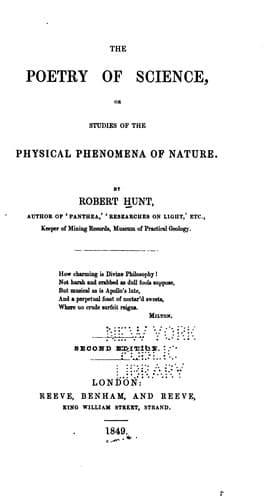
The Poetry of Science; or, Studies of the Physical Phenomena of NatureHunt, Robert
Philosophy
The Poetry of Science; or, Studies of the Physical Phenomena of Nature
Hunt, Robert
Physics; Science
Hydrogen and oxygen, in combining, lose their gaseous forms, and are
condensed into a liquid--water. Sulphuric acid is intensely sour and
corrosive; potash is highly caustic; but united they form a salt
which is neither: they appear to have destroyed the distinguishing
characters of each other. Combined bodies frequently occupy less space
than they did previously to combination, of which numerous particular
instances might be adduced. Gases in many cases undergo a remarkable
condensation when chemically combined. In slaking lime, the water
becomes solid in the molecules of the hydrate of lime formed, and the
intense heat produced arises from the liberation of that caloric which
had been employed to keep the water liquid. When a solid passes into
the liquid state, cold is produced by the abstraction from surrounding
objects of the heat required to effect fluidity. An alteration of
temperature occurs whenever chemical change takes place, as we have
already shown, with a few trivial and uncertain exceptions. The
disturbance caused by the exercise of the force of affinity frequently
leads to the development of several physical powers.
Changes of colour commonly arise; indeed, there does not appear to be
any relation between the colour of a compound and that of its elements.
Iodine is of a deep iron-grey colour; its vapour is violet; yet it
forms beautifully white salts with the alkalies, a splendid red salt
with mercury, and a yellow one with lead. The salts of iron vary from
white and yellow to green and dark brown. Those of copper, a red metal,
are of a beautiful blue and green colour, and the anhydrous sulphate is
white.
Isomorphism, which appears in a very remarkable manner among the
organic compounds, has, under the head of crystallization, already had
our attention. There is also a class of bodies which are said to be
_isomeric_; that is, to have the same composition, although different
in their physical characters. But the idea that bodies exist, which,
although of a decidedly different external character, are of exactly
the same chemical composition and physical condition, is not tenable;
and in nearly all the examples which have been carefully examined, a
difference in the aggregate number of atoms, or in the mode in which
those atoms have respectively arranged themselves, or that peculiar
physical difference designated by the term _allotropy_, has been
detected.
Oil of turpentine and oil of lemons have the same composition, each
being composed of five equivalents of carbon and four of hydrogen.
These substances form, from the striking difference perceptible in
their external characters, a good example of isomerism.
The laws of organic chemistry are not, however, the same as those
applying to inorganic combinations. Organic chemistry is well defined
by Liebig, as the chemistry of compound radicals; and under the
influence of vitality, nature produces compounds which have all the
properties of simple elements.[211]
Public-domain text, read in full here on John Shaqi.
Reviews
Reviews
No reviews yet
Be the first to share your thoughts on this work.
Elsewhere in the archive
Join the Discussion
Join the discussion
Sign in to leave a comment or review.
Sign InorCreate an account