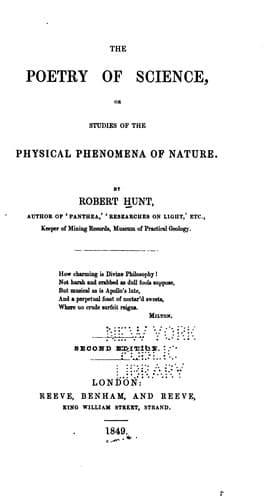
The Poetry of Science; or, Studies of the Physical Phenomena of NatureHunt, Robert
Philosophy
The Poetry of Science; or, Studies of the Physical Phenomena of Nature
Hunt, Robert
Physics; Science
few saline springs, and in combination with silver; but we have no
evidence to show that its uses are important in nature.
Hydrogen, again, unites with carbon in various proportions, producing
the most dissimilar compounds. The air evolved from stagnant water,
and the fire-damp of the coal mine, are both carburetted hydrogen; and
the gas which we employ so advantageously for illumination, is the
same, holding an additional quantity of carbon in suspension. Naphtha,
and a long list of organic bodies, are composed of these two chemical
elements.
These combinations lead us, naturally, to the consideration of the
great chemical phenomena of combustion, which involve, indeed, the
influences of all the physical powers. By the application of heat,
we produce an intense action in a body said to be combustible; it
burns,--a chemical action of the most energetic character is in
progress, the elements which constitute the combustible body are
decomposed, they unite with some other elementary principles, and new
compounds are formed. A body burns--it is entirely dissipated, or it
leaves a very small quantity of ashes behind unconsumed, but nothing
is lost. Its volatile parts have entered into new arrangements, the
form of the body is changed, but its constituents are still playing an
important purpose in creation.
The ancient notion that fire was an empyreal element, and the Stahlian
hypothesis of a phlogistic principle on which all the effects of
combustion depended,[219] have both given way to the philosophy of the
unfortunate Lavoisier--which has, indeed, been modified in our own
times--who showed that combustion is but the development of heat and
light under the influence of chemical combination.
Combustion was, at one period, thought to be always due to the
combination of oxygen with the body burning, but research has shown
that vivid combustion may be produced where there is no oxygen. The
oxidizable metals burn most energetically in chlorine, and some of
them in the vapour of iodine and bromine, and many other unions take
place with manifestations of incandescence. Supporters of combustion
were, until lately, regarded as bodies distinct from those undergoing
combustion. For example, hydrogen was regarded as a combustible body,
and oxygen as a supporter of combustion. Such an arrangement is a
most illogical one, since we may _burn_ oxygen in an atmosphere of
hydrogen, in the same manner as we burn hydrogen in one of oxygen; and
so, in all the other cases, the supporter of combustion may be burnt
in an atmosphere formed of the, so called, combustible. The ordinary
phenomena of combustion are, however, due to the combination of oxygen
with the body burning; therefore every instance of oxidization may be
regarded as a condition of combustion, the difference being only one of
degree.
Public-domain text, read in full here on John Shaqi.
Reviews
Reviews
No reviews yet
Be the first to share your thoughts on this work.
Elsewhere in the archive
Join the Discussion
Join the discussion
Sign in to leave a comment or review.
Sign InorCreate an account