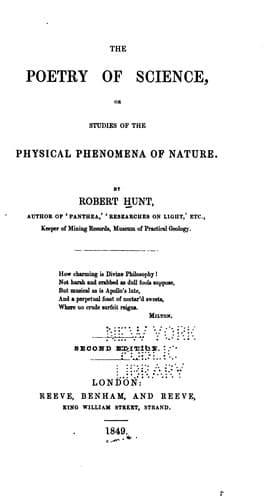
The Poetry of Science; or, Studies of the Physical Phenomena of NatureHunt, Robert
Philosophy
The Poetry of Science; or, Studies of the Physical Phenomena of Nature
Hunt, Robert
Physics; Science
Every equivalent of carbon and of hydrogen in the burning body unites
with two equivalents of oxygen, in strict conformity with the laws
of combination. The flame of hydrogen, if pure, gives scarcely any
light, but combined with the solid particles of carbon, it increases
in brightness. The most brilliant of the illuminating gases is the
olefiant gas, produced by the decomposition of alcohol, and it is
only hydrogen charged with carbon to the point of saturation. Flame
is a cone of heated vapour, becoming incandescent at the points of
contact with the air; a mere superficial film only being luminous. It
is evident that all the particles of the gas are in a state of very
active repulsion over the surface, since flame will not pass through
wire gauze of moderate fineness. Upon this discovery is founded the
inimitable safety-lamp of Davy, by means of which the explosive gases
of a mine are harmlessly ignited within a cage of wire gauze. This
effect has been attributed to a cooling influence of the metal; but,
since the wires may be brought to a degree of heat but little below
redness without igniting the fire-damp, this does not appear to be the
cause. The conditions of the safety lamp may be regarded as presenting
examples exactly the converse of those already stated with reference to
the spheroidal state of water; and it affords additional evidence that
the condition of bodies at high temperatures is subject to important
physical changes.
The principle upon which the safety lamp is constructed is, that a
mixture of the fire-damp and atmospheric air in certain proportions
explodes upon coming in contact with a flame.
This mixture passes readily through a wire gauze, under all
circumstances, and it, of course, thus approaches the flame of the lamp
enclosed within such a material, and it explodes. But, notwithstanding
the mechanical force with which the exploding gas is thrown back
against the bars of its cage, it cannot pass them. Consequently, the
element of destruction is caught and caged; and notwithstanding its
fierceness and energy, it cannot impart to the explosive atmosphere
without, any of its force. No combustion can be communicated through
the wire gauze.
Public-domain text, read in full here on John Shaqi.
Reviews
Reviews
No reviews yet
Be the first to share your thoughts on this work.
Elsewhere in the archive
Join the Discussion
Join the discussion
Sign in to leave a comment or review.
Sign InorCreate an account