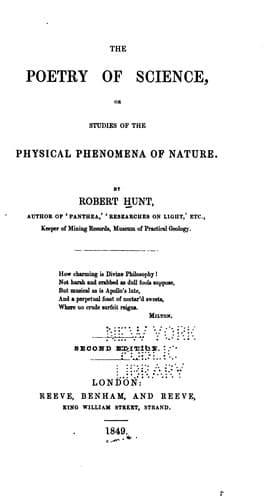
The Poetry of Science; or, Studies of the Physical Phenomena of NatureHunt, Robert
Philosophy
The Poetry of Science; or, Studies of the Physical Phenomena of Nature
Hunt, Robert
Physics; Science
[225] “This scale, in which the humidity of the air is expressed,
is the simple natural scale in which air at its maximum of humidity
(_i.e._, when it is saturated with vapour) is reckoned as = 100, and
air absolutely deprived of moisture as = 0; the intermediate degrees
are given by the fraction 100 × actual tension of vapour ÷ tension
required for the saturation of the air at its existing temperature.
Thus, if the air at any temperature whatsoever contains vapour of half
the tension, which it would contain if saturated, the degree is 50; if
three-fourths, then 75; and so forth. Air of a higher temperature is
capable of containing a greater quantity of vapour than air of less
temperature; but it is the proportion of what it does contain, to what
it would contain if saturated, which constitutes the measure of its
dryness or humidity. The capacity of the air to contain moisture being
determined by its temperature, it was to be expected that an intimate
connection and dependence would be found to exist between the annual
and diurnal variations of the vapour and of the temperature.”--Sabine,
_On the Meteorology of Toronto_; Reports of the British Association,
vol. xiii. p. 47. _The Temperature Tables_: by Prof. W. H. Dove;
Reports for 1847 should be consulted.
[226] Sir David Brewster’s _Optics_, and Memoirs in the Philosophical
Transactions. Sir John Herschel’s Treatise on _Light_, Encyclopædia
Metropolitana.
[227] _On the Colour of Steam under certain circumstances_: by
Professor Forbes; Philosophical Magazine, vol. xiv. p. 121, vol. xv.
p. 25. In the first paper the following remarks occur:--“I cannot
doubt that the colour of watery vapour under certain circumstances
is the principal or only cause of the red colour observed in clouds.
The very fact that that colour chiefly appears in the presence of
clouds is a sufficient refutation of the only explanation of the
phenomena of sunset and sunrise, having the least plausibility, given
by optical writers. If the red light of the horizontal sky were simply
complementary to the blue of a pure atmosphere, the sun ought to set
red in the clearest weather, and then most of all; but experience shows
that a lurid sunrise or sunset is _always_ accompanied by clouds or
diffused vapours, and in a great majority of cases occurs when the
changing state of previously transparent and colourless vapour may be
inferred from the succeeding rain. In like manner, terrestrial lights
seen at a distance grow red and dim when the atmosphere is filled
with vapour soon to be precipitated. Analogy applied to the preceding
observations would certainly conduct to a solution of such appearances;
for I have remarked that the existence of vapour of high tension is
by no means essential to the production of colour, though of course
a proportionally greater thickness of the medium must be employed to
produce a similar effect when the elasticity is small.”
Public-domain text, read in full here on John Shaqi.
Reviews
Reviews
No reviews yet
Be the first to share your thoughts on this work.
Elsewhere in the archive
Join the Discussion
Join the discussion
Sign in to leave a comment or review.
Sign InorCreate an account